
Base Power Raises $1B at a $13B Valuation to Support the Grid With Home Batteries
August 3, 2026
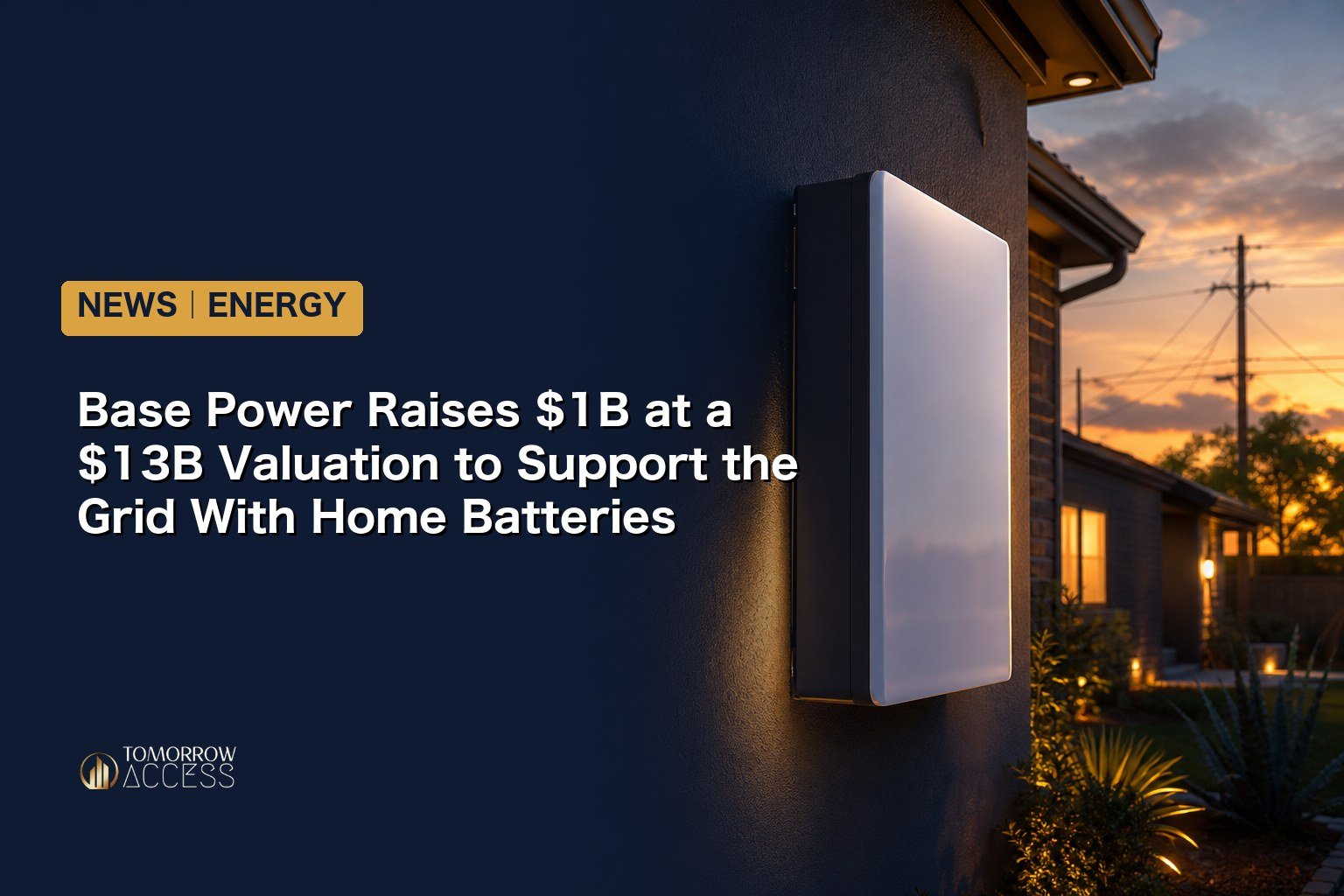
Base Power, the Texas home battery startup, announced a $1 billion Series D on August 3, valuing the company at $13 billion post-money. The company says its total funding now exceeds $2.5 billion.
The startup puts subscription-based home batteries on customers’ properties and sells the stored power back to the grid — a distributed answer to surging AI-driven electricity demand.
A Second Billion in Under a Year
The round was led by Ribbit, Addition, Valor Equity Partners, and JPMorganChase’s strategic investment group, with participation from Altimeter, Coatue, and Energy Impact Partners. Existing backers including Thrive Capital and a16z reinvested. According to TechCrunch, the raise comes less than a year after the company’s previous billion-dollar round.
Alongside the funding, Base Power launched Base Core, which stores 39.2 kWh per unit, or 78.4 kWh in a two-unit setup. The company builds it at Base Factory 1 in Austin, Texas, at a rate of thousands of units per month. Installing the battery unit itself takes under an hour, the company says, though deployment happens over two visits, with separate electrical work done ahead of the battery installation.
According to TechCrunch, the company is completing about 100 installations a day and aims to double that pace by the end of 2026. Its deployed fleet already exceeds 500 megawatt-hours, across Texas and Illinois.
Starting at $695 in Oncor Territory: The Subscription Grid Model
Most home battery systems cost thousands of dollars upfront. Base Power instead uses a subscription model. In the service area of Oncor, Texas’s largest transmission and distribution utility, a one-battery setup runs $695 for installation plus $19 a month, and a two-battery setup costs $995 for installation plus $29 a month. Electricity rates vary by region and plan; the company’s 36-month Oncor plan advertises 14.3 cents per kWh, delivery charges included, at 2,000 kWh of monthly usage.
Base Power retains ownership of the batteries. It aggregates them and sells stored electricity back to the grid at peak demand. In regulated markets, it works with utilities to place batteries in homes and relieve local grid strain; the company says its utility partnerships — including up to 10 megawatts with El Paso Electric, 40 megawatts with Austin Energy, and 100 megawatts with CoServ — total more than 200 megawatts.
For households, the batteries also provide backup power during outages. A single Base Core is rated for 12 to 18 hours of typical use, or up to 36 hours with reduced consumption.
Betting on Distributed Power While Others Go Big
The backdrop is a surge in US electricity demand, driven by electrification and AI data center construction. The strain is especially visible in PJM, the regional transmission organization whose territory stretches from the East Coast into the Midwest and includes many data centers. There, data-center-driven demand growth is squeezing power supply and grid capacity. Northern Illinois, where Base Power operates, falls within PJM territory.
One response has been to pursue centralized megaprojects, such as a planned gas-fired power facility being developed by Chevron and Engine No. 1 to supply a Microsoft data center in Texas. Base Power is betting on the opposite approach: aggregating small, demand-side resources into grid capacity.
CEO Zach Dell is, per TechCrunch, the son of Dell CEO Michael Dell, who did not join the round.
What to Watch Next
The open items are execution: whether Base Power can double its installation pace to roughly 200 installations a day by the end of 2026, and how quickly Base Core production ramps in Austin.
Growth in utility partnerships beyond the current 200-plus megawatts will show how far the model can scale.
Sources
TNW – Base Power hits $13bn to turn homes into grid capacity
TechCrunch – Base Power raises another $1B to save the grid using backyard batteries
Base Power – $1B Series D Announcement (Business Wire)
Reuters – Base Power raises $1 billion, launches US-made home battery
El Paso Electric – Residential Distributed Energy Storage Program
Austin Energy – Austin Energy expands local battery storage
CoServ – CoServ and Base Power Launch 100 MW Residential Storage Program
Base Power – Installation Day Guide (Help Center)
Chevron – 20-Year Power Agreement with Microsoft
US Department of Energy – 2026 Draft National Transmission Needs Study