Zoox Wins First US Commercial Exemption for a Passenger-Carrying AV
July 31, 2026
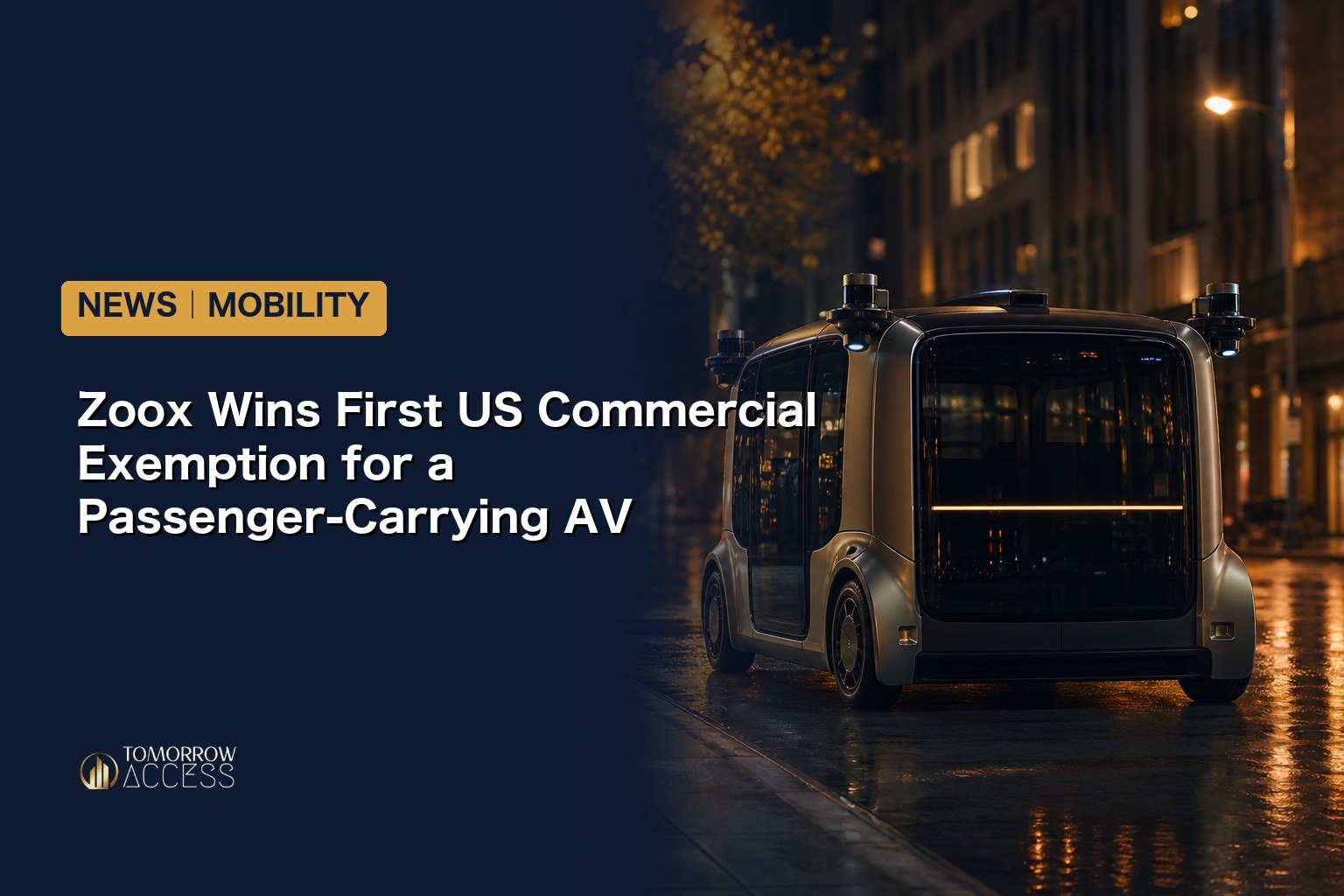
The National Highway Traffic Safety Administration (NHTSA) on July 30, 2026 granted Zoox, Amazon’s autonomous vehicle unit, a temporary commercial exemption from portions of eight Federal Motor Vehicle Safety Standards (FMVSS).
The decision lets Zoox manufacture and commercially deploy its purpose-built robotaxi — which has no steering wheel or pedals — and marks the first time the agency’s general exemption authority has covered a passenger-carrying vehicle equipped with an automated driving system (ADS).
Actually charging for rides still requires state and local approvals; paid service will start in Las Vegas, with more markets to follow, according to TechCrunch.
Many FMVSS Requirements Assume a Human Driver
Many of the current Federal Motor Vehicle Safety Standards assume a human driver. The exempted requirements include portions of the rules for windshield defrosting (FMVSS No. 103), brake systems (No. 135), and occupant crash protection (No. 208) — requirements within those standards that Zoox’s vehicle, which has no driver’s seat or manual controls, does not conform to by design.
Per the Federal Register notice, the robotaxi is symmetrical front to back and seats four passengers facing each other. In normal operation, remote assistants provide the vehicle with contextual information or suggested paths while the onboard ADS decides how to drive; separately, on-site Zoox support personnel with a direct and constant line of sight to the vehicle can operate it manually at low speed using a handheld controller. NHTSA’s safety-equivalence finding is limited to the specific exempted requirements — it is not a blanket certification of the ADS or of compliance with the remaining FMVSS. The general exemption authority previously covered Nuro’s occupantless delivery vehicle; Zoox is the first passenger-carrying ADS vehicle to receive one.
The Conditions: 2,500 Vehicles a Year, Through July 2028
Per the notice, the commercial exemption lets Zoox introduce up to 2,500 exempted vehicles in any 12-month period, through July 31, 2028. NHTSA issued an initial Operational Authorization alongside the exemption and may modify or expand it as the technology matures. The number of exempted vehicles that may operate simultaneously is capped by that initial authorization, which subsequent authorizations can revise. Zoox will not sell the vehicle; it owns and operates the fleet itself.
In a statement reported by TechCrunch, CEO Aicha Evans said Zoox is honored to receive the first-ever commercial exemption for a purpose-built robotaxi from NHTSA. An earlier federal exemption, granted in August 2025, permitted demonstration operations on public roads; Zoox’s free rides in San Francisco and Las Vegas have operated under state-level permissions, and commercial deployment was not covered.
The Federal Hurdle Is Cleared; States Come Next
Vehicle safety standards are federal, but permission to run a passenger service comes from each state. In California, where Zoox is headquartered, it holds driverless testing and pilot permissions but has not yet obtained the DMV’s autonomous vehicle deployment permit or the CPUC’s driverless deployment authorization required for paid driverless service, so rides there remain free, according to TechCrunch.
Among purpose-built designs without manual controls, Tesla’s Cybercab is still in public-road testing in Austin. Tomorrow Access has covered Tesla’s Cybercab testing and Mobileye’s planned 2027 US robotaxi service — Zoox has now moved a step ahead in securing federal clearance for commercial deployment of a purpose-built vehicle.
A Same-Day Push Toward a Single National AV Standard
The Zoox commercial exemption was part of a broader package announced the same day. NHTSA published an interim final rule making vehicles manufactured before an exemption takes effect eligible for commercial-deployment exemptions, updated its Part 555 application guidance and opened it to public comment, and is backing a three-year, $5 million “A2SCEND” consortium with SAE Industry Technologies Consortia to gather data for AV performance standards, aiming for a single national standard.
Administrator Jonathan Morrison described the package as a balanced approach to AV regulation. The agency is also reviewing an exemption application from Robomart, a Los Angeles startup whose low-speed delivery vehicle holds up to 500 pounds (about 227 kilograms).
What to Watch Next
Paid service is reported to begin in Las Vegas in August 2026, but the exact start date and pricing have not been announced. The Zoox commercial exemption is temporary and capped, so scaling beyond 2,500 vehicles a year or past July 31, 2028 will require permanent standards adopted through rulemaking or additional exemptions. Other questions include how the Operational Authorizations evolve, when California grants the required permits, and whether the effort to create a single national standard advances.
Sources
NHTSA – Cutting Red Tape to Safely Fast-Track Automated Vehicle Innovation
NHTSA – First-Ever Demonstration Exemption (August 2025)
TechCrunch – Zoox clears final federal hurdle to launch paid robotaxi service
The Next Web – Zoox wins first US approval to charge for no-wheel robotaxi rides
TechCrunch – Federal regulators give Zoox an exemption for its custom-built robotaxis (August 2025)
The Verge – Zoox cleared to charge for robotaxi rides (reported August 2026 start)
California DMV – Autonomous Vehicle Permit Holders
CPUC – Autonomous Vehicle Program Permits Issued
TechCrunch – Robomart unveils new delivery robot with $3 flat fee (source for 500-lb capacity)