San Francisco is the global capital of driverless cars. Hundreds of robotaxis glide through the city every day — no human behind the wheel, no drama. What was a science experiment just a few years ago is now woven into everyday life in the Bay Area.
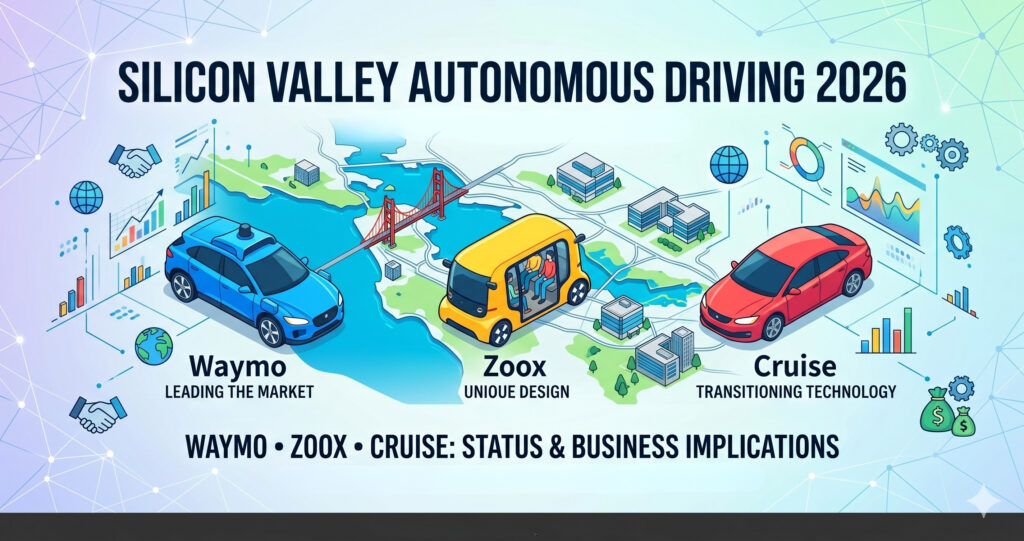
The 2026 AV landscape has split into two clear tiers: service providers who operate robotaxis you can ride today, and technology providers who supply the software and hardware powering the next wave. Here’s where each player stands — and how to get in one.
Service Providers: Robotaxis You Can Ride Today
Waymo — The Undisputed Leader
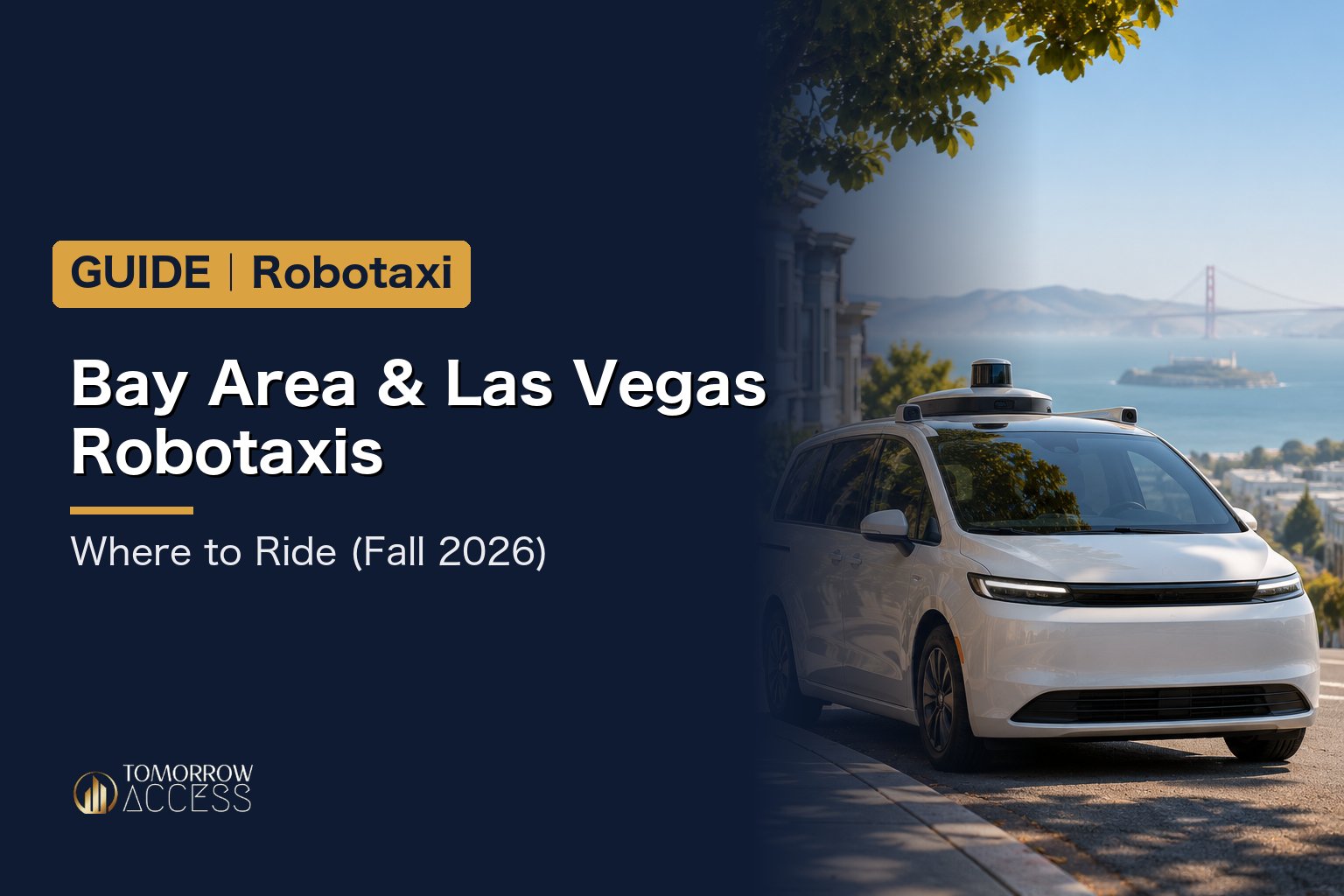
Waymo (Alphabet/Google) is the clear market leader. As of spring 2026, it operates about 3,000 robotaxis delivering roughly 500,000 paid rides per week, with service now spanning 11 U.S. cities including San Francisco, Los Angeles, Phoenix, Austin, Dallas, Houston, and Nashville. The Bay Area service zone covers more than 260 square miles — from San Francisco south through the Peninsula to Palo Alto and parts of San Jose.
In February 2026, Waymo began fully autonomous operations with its 6th-generation Waymo Driver on the Ojai (Zeekr RT) platform — a spacious minivan built with Chinese EV maker Zeekr, featuring 42% fewer sensor components than previous models while still using 13 cameras, 6 radars, and 4 LiDAR units. International expansion is next: Waymo began testing in London in April 2026, targeting a commercial launch by Q4 2026.
Zoox — Amazon’s Purpose-Built Robotaxi
Amazon-backed Zoox operates custom robotaxis in San Francisco and Las Vegas. Unlike Waymo, which converts existing vehicles, Zoox built its car from scratch as a robotaxi: bidirectional (no front or back), no steering wheel, four passengers facing each other in a lounge configuration.
After a major expansion in March 2026 — roughly quadrupling its SF coverage area and extending to the Las Vegas Strip — Zoox is testing in Austin and Miami ahead of paid service. Current rides are free through its Explorer waitlist program at zoox.com.
Tesla — Texas First, Bay Area TBD
Tesla launched a small commercial robotaxi pilot in Austin in 2025 and expanded to Dallas and Houston in April 2026 using Model Y SUVs with no safety driver. In the Bay Area, Tesla’s current service is a human-driven ride-hailing operation; the company does not yet have the permits required for autonomous robotaxi service in California.
Tesla’s camera-only approach (no LiDAR) remains its most debated design choice. The purpose-built Cybercab, unveiled in October 2024, has been announced for production but no confirmed delivery timeline has been set.
Uber — The AV Aggregator
Uber isn’t building AV technology itself — it’s positioning as the platform that aggregates multiple AV fleets. Active partnerships with Waymo (in Austin and Atlanta), Nuro, and May Mobility mean Uber riders will increasingly hail driverless cars without knowing who made the software. For businesses thinking about AV strategy, Uber’s marketplace model is worth watching: the distribution layer may matter as much as the technology.
Technology Providers: The Builders Behind the Scenes
Cruise — GM’s Pivot Away from Robotaxi
Cruise was once Waymo’s closest competitor, backed by GM, Honda, and SoftBank with over $10 billion invested. Following a pedestrian accident in October 2023 and a subsequent regulatory suspension, GM shut down Cruise’s public robotaxi operations in December 2024.
Today, GM is folding Cruise into its broader driver-assistance and personal AV efforts. No public robotaxi service is planned. The Super Cruise hands-free highway driving system — available in Cadillac, Chevrolet, and GMC vehicles — continues to expand independently.
Nuro — From Delivery Robot to AV Software Licensor
Mountain View-based Nuro raised $203 million in 2025 (backed by Nvidia and Uber) and pivoted from delivery robots to licensing AV software to automakers. Its partnership with Uber and Lucid Motors targets 20,000+ Nuro-powered robotaxis by the early 2030s.
In early 2026, Nuro began public-road testing in Tokyo using Toyota Prius vehicles equipped with its software — with human safety operators on board and the system initially running in shadow mode (the AI makes decisions without controlling the car). The company says its model adapted to Japan’s left-side driving without Japan-specific training data, a capability it calls “zero-shot” autonomy.
How to Ride Waymo in the Bay Area
In San Francisco and across the Bay Area, Waymo rides are broadly available — no invitation, no waitlist needed. Here’s how to get in one.
Step by step:
1. Download the Waymo app (iOS or Android) — setup takes about 2 minutes
2. Enter your destination and request a ride
3. When the car arrives, use the app’s Find my car feature — tap for directions, play a chime, or honk the horn to locate your vehicle
4. Unlock the door with your app, buckle up, and tap “Start Ride”
5. Watch the passenger screen to see what the car’s sensors detect in real time
Coverage & pricing:
The Bay Area zone covers San Francisco, Daly City, South SF, San Bruno, Millbrae, Burlingame, San Mateo, Palo Alto, Mountain View, Los Altos, and parts of San Jose. Freeway access along Highway 101, I-280, and SR-92 is available but still rolling out — if it’s not yet enabled in your app, you can join the interest list from the “My trip” tab.
Fares are roughly 10–30% higher than Uber (~$20 average vs. ~$17 for Uber as of early 2026), with no tipping. Service is 24/7.
Airport access:
SJC offers Waymo pickup and dropoff service, with designated pickup points depending on terminal (open since November 2025).
SFO access launched January 29, 2026 via the Rental Car Center (accessible by AirTrain) — currently rolling out gradually and may not yet be available to all riders.
What to expect:
Smooth, calm, and surprisingly confident. The car handles SF’s hills, tight intersections, and highway merges without hesitation. There’s a touchscreen for temperature and music and a “pull over” button.
If the vehicle needs guidance, a team of remote assistance agents can respond — though they advise rather than directly control the car.
Safety data: Waymo has logged 170M+ fully autonomous miles, with 92% fewer serious injury or worse crashes than an average human driver over the same distance in its operating cities.
Tips:
- Try a nighttime ride — the live sensor visualization on the passenger screen is worth seeing
- If freeway access is enabled in your app, choose a freeway route for Peninsula trips — typically faster
- Close the door firmly — the car senses the seal and prepares to depart
- Don’t leave belongings — if you do, contact Waymo’s 24/7 Support or Lost & Found through the app or at waymo.com/contact
The Bottom Line
The Silicon Valley AV market in 2026 is no longer a pilot program — it’s a real industry with real revenue and real competition. Waymo leads with commercial operations now spanning 11 U.S. cities.
Zoox is building toward paid service with Amazon’s backing. Tesla is expanding in Texas while California awaits. Behind the scenes, Nuro is betting that the real money is in software licensing, not fleet operation. And Cruise’s story — $10 billion spent, then a hard pivot — is a reminder that capital alone doesn’t guarantee a robotaxi future.
If you’re in the Bay Area, there’s no better way to understand where transportation is heading than to experience it firsthand. Download the Waymo app and take a ride.
Sources
- Waymo One San Francisco – Official Service Page
- Waymo Blog: Clear skies and autonomous Waymo rides at SFO (Jan 2026)
- CNBC: Waymo begins deploying next-gen Ojai robotaxis (Feb 2026)
- TechCrunch: Waymo opens robotaxi service in Nashville, partners with Lyft (Apr 2026)
- TechCrunch: London gets closer to its first robotaxi service as Waymo begins testing (Apr 2026)
- TechCrunch: Tesla brings robotaxi service to Dallas and Houston (Apr 2026)
- Electrek: California regulator confirms Tesla holds no AV permits (Mar 2026)
- TechCrunch: Nuro testing autonomous tech in Tokyo (Mar 2026)
- Waymo Safety: 170M+ autonomous miles, 92% fewer serious injury or worse crashes
- TechCrunch: The price gap between Waymo and Uber is narrowing (Jan 2026)
- CNBC: Amazon’s Zoox to expand to Austin, Miami; SF and Las Vegas coverage grows (Mar 2026)
- CNBC: GM exits robotaxi market, will bring Cruise operations in-house (Dec 2024)
- TechCrunch: Nvidia backs AV startup Nuro in $203M funding round (Aug 2025)
📋 Note: Information reflects the state of AV services as of April 2026. Service areas, availability, and pricing are subject to change. Always check official sites for the latest details.