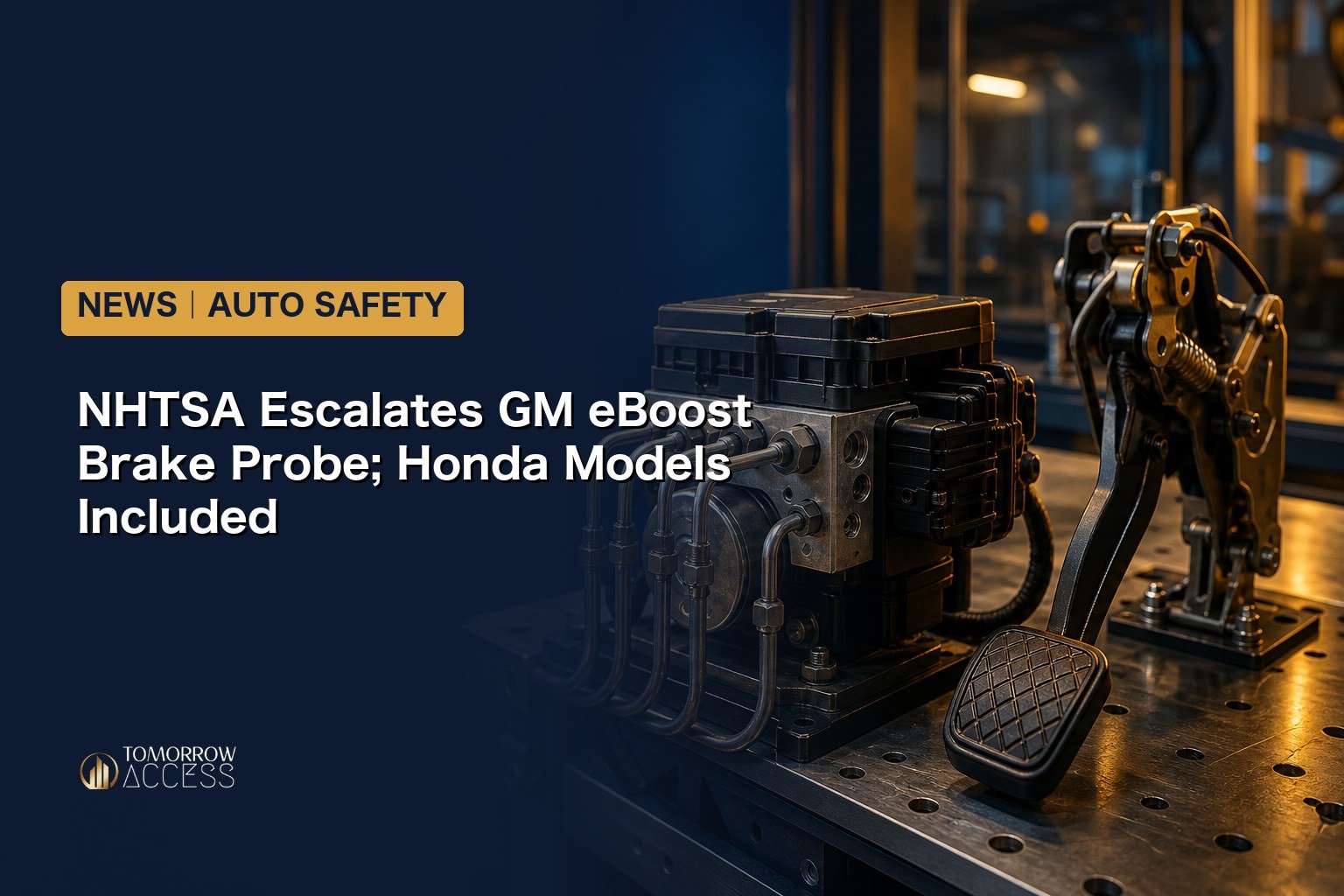
NHTSA Escalates GM eBoost Brake Probe; Honda Models Included
August 24, 2026
The National Highway Traffic Safety Administration (NHTSA) has escalated its review of the GM eBoost brake system to its highest level of defect investigation.
The NHTSA opening resume lists an estimated population of 1,164,820 GM vehicles from the 2023 through 2026 model years.
The Honda Prologue and Acura ZDX are also included in the engineering analysis as peer vehicles. Honda describes the models as co-developed with GM, while NHTSA says they were manufactured by GM.
Why the Regulator Escalated the Probe
NHTSA’s Office of Defects Investigation (ODI) opened Engineering Analysis EA26006 on August 21, 2026, taking over from Preliminary Evaluation PE24011, which it opened on April 11, 2024. An engineering analysis is the highest level of investigation ODI conducts, and the office often reaches it before asking a manufacturer to recall.
The opening resume counts 745 incident reports once duplicates are removed: 227 filed with ODI and 531 received through the manufacturer. It records 22 crashes or fires, five injury incidents involving six injuries, and no fatality incidents.
The case started with complaints about a loss of brake assist in 2023 model year Cadillac Lyriq vehicles. Owners described a hard brake pedal followed by a “Brake System Failure” message at startup or while driving.
NHTSA also handles federal regulatory decisions involving automated vehicles, including the temporary exemption that cleared Zoox to commercially deploy its purpose-built robotaxis without steering wheels or pedals.
A Fractured Spindle, and Reports That Do Not Match GM’s Account
eBoost is GM’s brake-by-wire system, which electronically processes brake-pedal input to control the hydraulic braking system. GM says the system allows precise tuning of brake-pedal feel, including different responses for different drive modes. TechCrunch reports that eBoost was introduced in 2019.
GM told NHTSA that if the spindle inside eBoost fractures, anti-lock brakes (ABS), stability control, and traction control keep working until the vehicle comes to a complete stop, and that those functions, along with brake assist, are lost at that point. The Electronic Brake Control Module then sets a diagnostic trouble code, triggering a chime, a “Service Brake System” message, and warning lights, and vehicle speed is limited to 70 kph, or 43 mph.
The complication is that reports kept arriving after PE24011 opened, and some do not match that account. They describe brake assist disappearing immediately while the driver was braking to slow down, rather than after the vehicle stopped. ODI says a sudden loss of assist during braking can extend stopping distance and raise the risk of a crash or injury.
What It Means That Honda Models Are In as Peer Vehicles
ODI lists the eBoost-equipped vehicles it knows of: 2023-2026 model year Cadillac Lyriq, Chevrolet Colorado, and GMC Canyon; 2024-2026 Buick Enclave and Envision, Chevrolet Blazer EV, Equinox EV, and Traverse, Cruise Origin, and GMC Acadia; and 2025-2026 Cadillac Celestiq and Optiq.
It adds that the 2024-2026 Acura ZDX and Honda Prologue – co-developed by Honda and GM and built by GM – will be included in the engineering analysis as peer vehicles. The document also names American Honda Motor among affected manufacturers.
The scope is not limited to electric vehicles. The Chevrolet Colorado, GMC Canyon, and Buick Enclave and Envision carry the same system with combustion powertrains.
Because brake electronics advanced alongside electrification, a single component issue now reaches across brands and drivetrains. For any automaker that fills out a lineup through contract manufacturing or a shared platform, a component-driven investigation arrives from outside its own engineering decisions.
What to Watch Next
NHTSA has only opened the analysis, setting out neither a conclusion nor a timeline. This stage often precedes a recall request, but there is no decision that EA26006 will get there.
GM told TechCrunch it takes the reports seriously, has conducted a thorough investigation, and determined that the alleged condition does not present an unreasonable risk to motor vehicle safety. How ODI weighs the reports that conflict with GM’s account is the next thing to watch.
Sources
NHTSA ODI – Opening Resume, Engineering Analysis EA26006
NHTSA ODI – Opening Resume, Preliminary Evaluation PE24011
TechCrunch – Brake problems in GM EVs draw greater federal scrutiny
autoevolution – NHTSA Expands GM eBoost Brake Assist Investigation to 1.1 Million Vehicles
GM News – The GM EV1 changed how cars stop
Chevrolet Silverado EV Owner’s Manual 2024 – Electric Brake Boost (GM)
Honda – Honda electric vehicles (EV): co-developed with General Motors