
The AI investment wave is shifting — from software to the physical world.
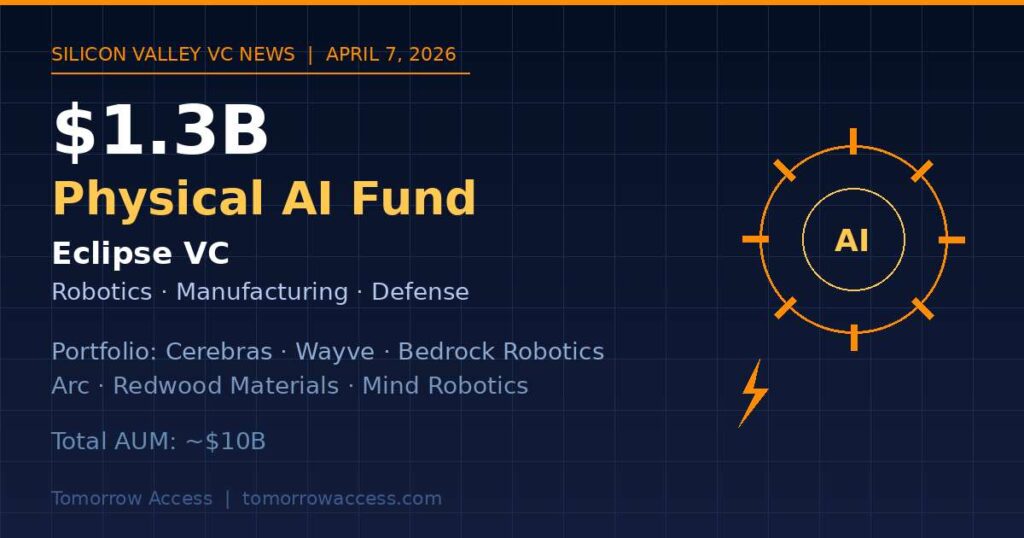
On April 7, 2026, Silicon Valley VC firm Eclipse announced a $1.3 billion fund dedicated to “Physical AI” startups in manufacturing, robotics, energy, and defense. It is the firm’s largest raise to date, bringing its total assets under management to roughly $10 billion.
For global enterprises in industrial sectors, this is a signal worth paying close attention to.
1. 💡 The Fund — What $1.3 Billion Buys
Eclipse structured the raise as two vehicles: Fund VI ($720M, early-stage) and Early Growth III ($591M, growth-stage). Together they represent a significant scaling of the firm’s bet on physical-world AI.
What sets Eclipse apart is its intention to go beyond passive investing. The firm will use a portion of capital to incubate startups from scratch — acting as a co-founder rather than just a check-writer.
This “builder VC” model — a less common approach among deep tech investors — suggests, in our analysis, that Eclipse believes the most consequential Physical AI companies of the next decade may not yet have been founded. (Eclipse partner Jiten Behl confirmed the incubation process has already started, per TechCrunch.)
The fund’s LPs include U.S. university endowments, foundations, and hospital systems — suggesting that major institutional investors share Eclipse’s thesis.
(Source: TechCrunch, Bloomberg, April 7, 2026)
2. 🤖 Why “Physical AI” — And Why Now
Eclipse’s portfolio tells a clear story about its investment thesis. Current holdings include Arc (electric boats), Redwood Materials (battery recycling), Bedrock Robotics (autonomous construction vehicles), Wayve (self-driving technology), Mind Robotics (industrial robots), and Cerebras (AI chips challenging Nvidia). The common thread: AI embedded in machines that operate in the real world.
“Physical AI” is distinct from conversational AI like ChatGPT. It refers to AI systems integrated into robots, manufacturing equipment, vehicles, and infrastructure — designed to perceive, decide, and act in physical environments.
Three forces are driving this shift right now:
① LLM investment is maturing. The initial wave of large language model funding is reaching saturation. VCs are increasingly looking to the physical world as the next frontier for outsized returns.
② Hardware costs are collapsing. Sensors, actuators, and edge inference chips have become dramatically cheaper, lowering the barrier to deploying AI in factories, construction sites, and logistics facilities.
③ Policy is accelerating demand. U.S. reshoring and defense modernization policies are generating urgent demand for AI-powered automation in domestic manufacturing and security applications.
3. 🏭 What Silicon Valley Is Reading in the Industrial AI Moment
For enterprise strategy teams, the Eclipse raise has three concrete implications:
Competitive awareness. Eclipse’s portfolio already includes companies operating in areas that overlap with major industrial sectors globally — autonomous vehicles, construction robotics, advanced manufacturing. Within a few years, several of these startups may enter markets currently dominated by established players. Companies that do not track this landscape risk being caught off-guard.
Partnership opportunity. Eclipse’s builder VC model creates a rare opening for industrial corporations with deep domain knowledge and manufacturing capabilities. A collaboration structure — manufacturing know-how paired with Silicon Valley AI — could be a compelling path for companies seeking to move faster than internal R&D allows.
Strategic framing. Explicitly categorizing “Physical AI” as a distinct investment and business development theme — covering autonomous robots, edge AI, and AI-driven energy management — creates a systematic lens for identifying opportunities that might otherwise be scattered across multiple business units.
Takeaway: The Second Chapter of AI Is Happening in the Physical World
Eclipse’s $1.3B raise signals that the AI revolution’s second chapter is underway — and it is playing out in factories, construction sites, and defense installations, not just in chat interfaces.
For enterprises with deep roots in industrial sectors, this moment is both a competitive threat and a strategic opening. Understanding where Silicon Valley capital is flowing — and moving early — may prove to be one of the defining decisions of the next business cycle.
Sources
- TechCrunch: VC Eclipse has a new $1.3B fund to back and build ‘physical AI’ startups
- Bloomberg: Cerebras Backer Eclipse Raises $1.3 Billion for Robotics, AI Infrastructure
- TechFundingNews: Eclipse Ventures Raises $1.3B for Physical AI
- Benzinga: VC Firm Eclipse Raises $1.3 Billion To Chase Hard-Tech Boom