
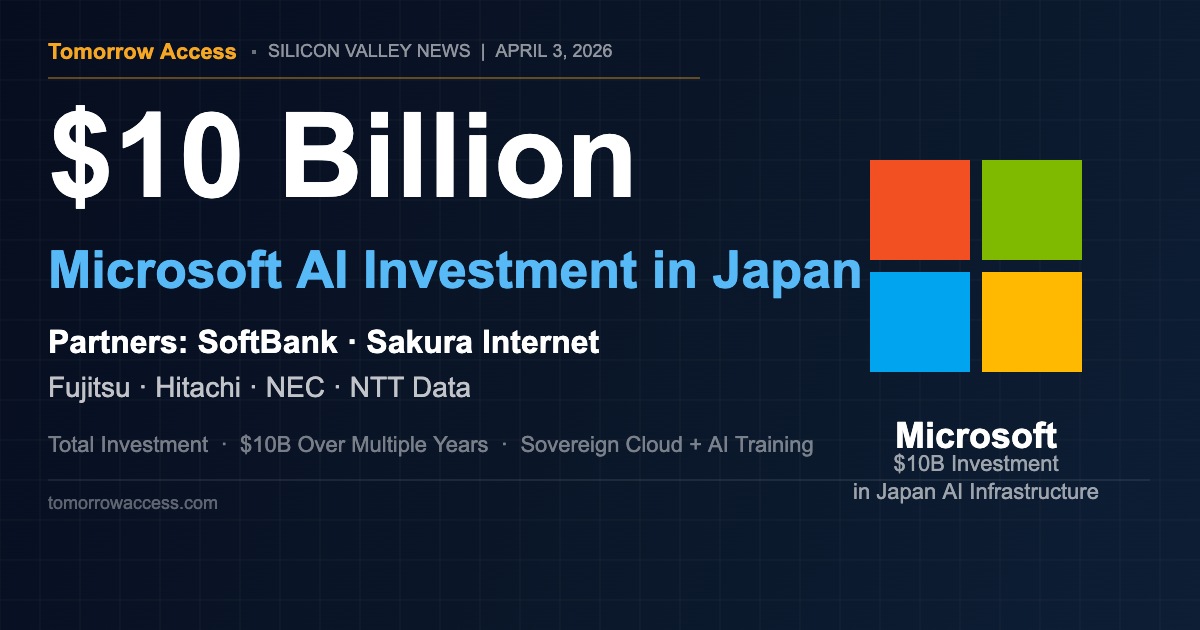
On April 3, 2026, Microsoft announced a $10 billion (approximately ¥1.6 trillion) investment into Japan — its largest-ever commitment to the country. Partnering with SoftBank, Sakura Internet, Fujitsu, Hitachi, NEC, and NTT Data, the company is building a sovereign AI infrastructure designed to keep Japanese data on Japanese soil.
The announcement sent Sakura Internet’s stock up as much as 20.2% on the day. But what’s driving Microsoft’s outsized bet on Japan, and what does it mean for the broader AI landscape?
1. The Investment at a Glance: What $10 Billion Buys
Microsoft’s Japan commitment rests on three pillars: Technology, Trust, and Talent. Between 2026 and 2029, the company will invest $10 billion in expanding data center capacity, GPU-powered AI computing through Azure, and workforce development across Japan.
SoftBank and Sakura Internet will serve as key infrastructure partners. The architecture follows a “sovereign cloud” model — all data generated in Japan stays within Japan’s borders, directly addressing the security concerns that have historically slowed cloud adoption in finance, healthcare, and government.
This announcement builds on Microsoft’s April 2024 investment of $2.9 billion in Japan — the new commitment is roughly 3.4 times larger. Sakura Internet’s share price surged as much as 20.2% on the day of the announcement, reflecting strong market confidence in the deal.
(Source: Microsoft Official Blog, April 3, 2026)
2. Talent, Partners, and the Road to 2030
Alongside infrastructure, Microsoft has set an ambitious workforce target: training 1 million AI-skilled workers in Japan by 2030, in partnership with Fujitsu, Hitachi, NEC, and NTT Data.
Enterprise adoption is already well underway. According to Microsoft’s figures, 94% of Nikkei 225 companies have already deployed Microsoft 365 Copilot — a remarkably high penetration rate by any global standard. A Microsoft survey also found that roughly one in five working-age adults in Japan is already using generative AI, ahead of the global average of approximately one in six.
3. What Silicon Valley Is Reading in Japan’s AI Moment
From our vantage point in Silicon Valley, what stands out is the speed at which Big Tech is moving to secure its position in individual national markets. As governments worldwide push for AI infrastructure sovereignty — demanding that data remain within their borders — Microsoft, alongside Amazon and Google, is aggressively accelerating investment in localized AI infrastructure.
The race to control Japan’s AI infrastructure is effectively underway. The question now is who captures the position first, and how deeply they can embed themselves in Japan’s enterprise and public sectors.
Takeaway: Japan Has Emerged as a Strategic AI Battleground
This announcement makes clear that Japan is no longer a peripheral market in the global AI investment map — it’s a priority. Sovereign cloud infrastructure, once fully deployed, is likely to unlock AI adoption in sectors that have historically been reluctant to move to the cloud, including finance, healthcare, and government.
For companies tracking investment opportunities tied to AI infrastructure in Japan, the ecosystem being built right now — across data centers, AI tooling, and enterprise software — represents a significant, multi-year growth runway. Now is the time to strengthen your ties to Silicon Valley and position for what’s coming.
(Sources: Microsoft Official Blog / Bloomberg / CNBC, April 3, 2026)