Tesla Cybercab: A Steering-Wheel-Free Robotaxi Begins Testing in Austin
July 2, 2026
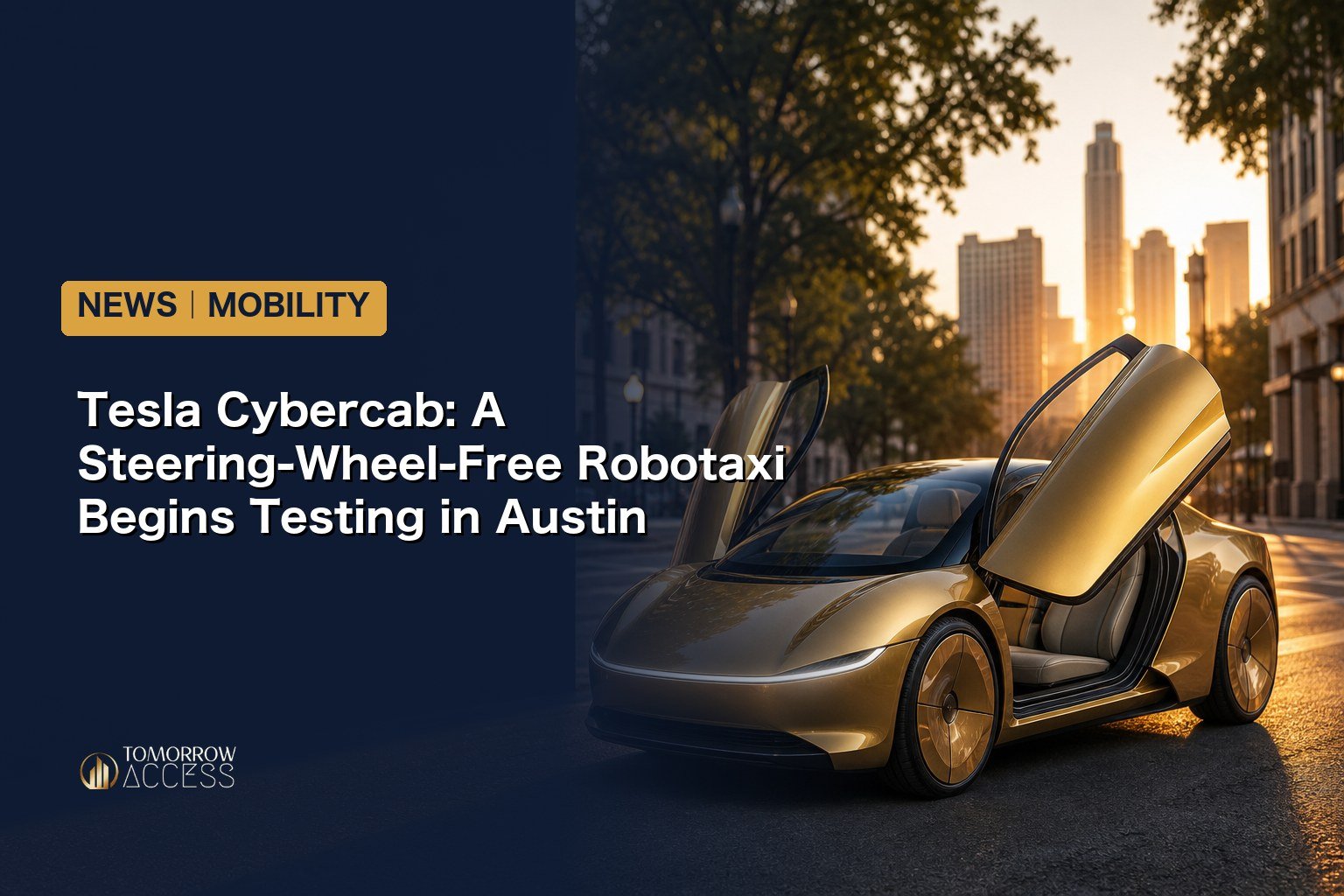
The Tesla Cybercab — a two-seat self-driving car with no steering wheel and no pedals — has begun public-road testing in Austin, Texas.
What stands out is not just that this car is now on public roads, but that Tesla has moved a step closer to its long-standing goal of running a self-driving taxi network across the US.
This article walks through where the vehicle and its regulation stand, how Tesla’s and Waymo’s strategies differ, and what to watch from here.
The Tesla Cybercab Hits Public Roads: From Reveal to Real Driving
A near-production Cybercab — two seats, no steering wheel, no pedals — was seen driving through Austin in a video posted on X, the platform owned by CEO Elon Musk.
A safety monitor rides in the right-hand passenger seat, and this remains a public-road test rather than a commercial rollout.
The Cybercab, designed as a fully autonomous robotaxi that riders hail through Tesla’s app, was revealed in October 2024 — roughly a year and eight months ago.
Tesla has also run a Model Y-based Robotaxi service in Austin for about a year, at times with safety monitors on board.
According to TechCrunch, Tesla has in recent weeks been testing wheel-and-pedal prototype Cybercabs across several US cities and parking hundreds of them in lots.
That said, a car beginning to drive on public roads is a different matter from being able to operate driverless, at scale, and commercially.
A Regulatory Bottleneck: Revisiting FMVSS No. 135
One of the major constraints on building and deploying a car with no steering wheel or pedals has been safety regulation. US Federal Motor Vehicle Safety Standards (FMVSS) have assumed the presence of manual braking controls.
On June 25, 2026, the National Highway Traffic Safety Administration (NHTSA) began rulemaking to amend FMVSS No. 135 — the braking standard — so that manual brake pedals would not be required in “vehicles designed to be driven exclusively by automated driving systems.”
This is a proposal, not a final rule. Reports suggest it could take effect later this year, but it is currently in its public comment period.
Braking-performance requirements such as stopping distance would remain in place, and vehicles with human driving controls would keep all existing requirements. Under the current framework, selling a car with no steering wheel or pedals would typically require a case-by-case exemption. Tesla has not formally applied for such an exemption for the Cybercab; if the rule changes, that route may no longer be necessary.
If the proposal holds, one precondition for the Cybercab would fall into place.
Cameras-Only Tesla vs. Multi-Sensor Waymo: Diverging Bets
Musk and other Tesla executives argue they can compete with Waymo, which is ahead in US commercial robotaxi deployment. Their core reason is that Tesla develops both the car and the driving software in-house, which it expects to make costs easier to control than Waymo, which sources vehicles through partnerships with brands such as Jaguar and Zeekr.
On hardware, Tesla aims for full autonomy using cameras alone, while Waymo combines a sensor suite that includes lidar and radar. That gap is not only about cost — it also reflects a design philosophy of layering perception methods beyond cameras to cross-check for safety.
Still, both companies have real-world challenges to work through. Tesla has yet to deploy a fully autonomous car at scale, and its Austin service has seen minor crashes.
Waymo, too, has issued recalls tied to highway construction zones and to flooding in heavy rain, and its behavior around school buses is under investigation by the National Transportation Safety Board (NTSB), among others.
What to Watch Next
The near-term focus is whether the NHTSA proposal clears its public comment period and is finalized this year, and when. It also remains undecided when Tesla will remove the front-seat safety monitor from the Cybercab public-road test, and how many Cybercabs it will deploy and how quickly. The crash and recall records of both Tesla and Waymo are also worth watching.
Sources
Tesla starts testing Cybercab without pedals or a steering wheel in Austin (TechCrunch)
Tesla reveals two Robotaxi crashes involving teleoperators (TechCrunch)
US proposes to drop brake pedal requirements for self-driving vehicles (Reuters)
Elon Musk hypes $30,000 Tesla self-driving Cybercab and larger Robovan at robotaxi event (CNBC)