Labor Transformed or Purpose Erased? A Survival Strategy on the Eve of “Superintelligence” in 2028
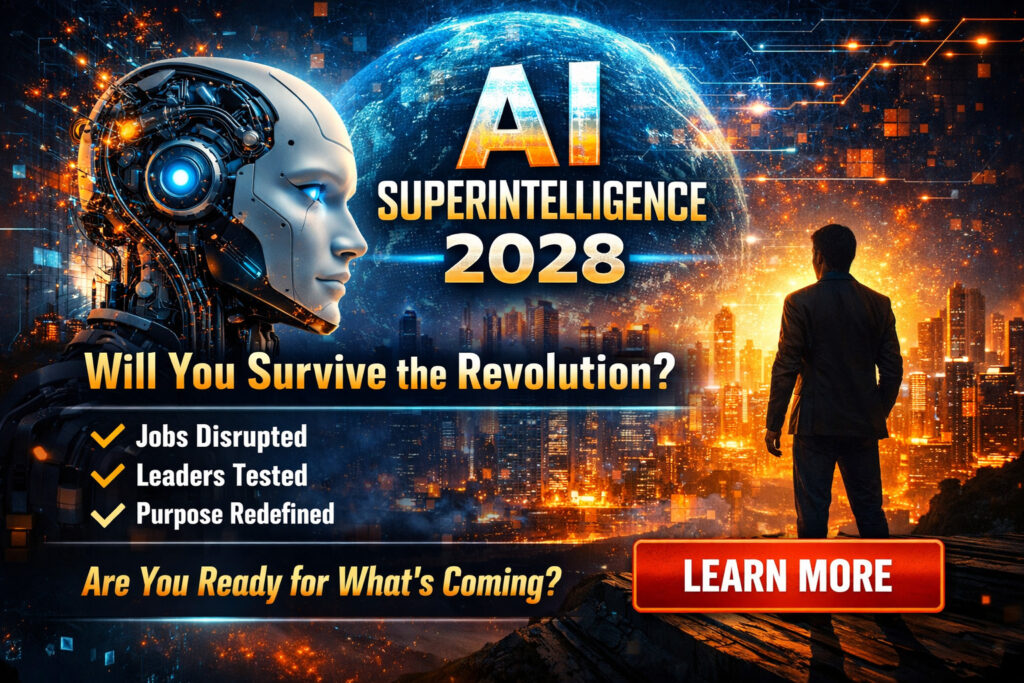
In Silicon Valley, the conversation has already moved beyond how to use AI effectively. As the possibility that AI could surpass human intelligence becomes increasingly plausible, a more fundamental question is emerging: How should we live in a world where human cognition is no longer dominant?
Two major developments now drawing global attention offer a clear window into the future we are rapidly approaching.
1. By 2028, the World’s Intellectual Capacity May Reside in Data Centers
On February 19, 2026, at the India AI Impact Summit 2026 in New Delhi, Sam Altman, CEO of OpenAI, issued a strikingly concrete prediction.
If the current exponential trajectory continues, he stated, “by the end of 2028, more of the world’s intellectual capacity could reside inside data centers than outside them.”
This is not a metaphor. It implies a structural inversion of cognitive power—a future where the combined problem-solving and value-generating capacity of AI systems exceeds that of all human brains combined.
Altman further projected that, at a certain point in the development of superintelligence, AI systems could outperform the world’s top CEOs—including himself—as well as leading scientists in delivering high-level results.
In other words, the center of intellectual gravity may shift from biological cognition to machine computation.
2. Economic Transformation—and the Reality of Job Disruption
Altman also offered profound insights into the economic and social consequences of this inflection point.
Explosive Growth and Collapsing Costs: AI advancement is expected to dramatically reduce the cost of goods and services while accelerating economic growth at an unprecedented pace. Through supply chain automation, robots will manufacture physical products more affordably, and access to high-quality healthcare and education could see a massive expansion.
The Difficulty of Competing with GPUs: At the same time, many existing jobs will be disrupted. Altman explicitly stated: “It’ll be very hard to outwork a GPU in many ways.”
While acknowledging that technology disrupts jobs, Altman remains fundamentally optimistic: “We always find new and better things to do.”
The author foresees that this transformation will ultimately lead humanity away from “mandatory survival labor” and toward activities that offer deeper fulfillment and purpose—a shift from working to survive, to living to contribute and create.
(Source: Sam Altman at “India AI Impact Summit 2026,” February 19, 2026)
3. Accenture’s Ultimatum: The Reality of the “AI Divide”
While the long-term vision may sound philosophical, the corporate response is already operational—and uncompromising.
On February 19, 2026, global consulting giant Accenture announced a rigorous new HR policy: for Senior Managers (SM) and Associate Directors (AD) and above, demonstrable, regular use of AI tools is now a mandatory prerequisite for promotion.
This is not about theoretical literacy. It is about measurable behavior—specifically, weekly engagement with internal AI platforms—being integrated directly into performance evaluation.
CEO Julie Sweet has previously signaled to investors that employees who fail to adapt to AI may ultimately have to “exit” the organization. This new policy formalizes that stance. While staff in 12 European countries and those working on U.S. government contracts are currently exempt, the message for global leadership is unambiguous: AI proficiency is now an indispensable condition for advancement.
AI has evolved from a “convenient tool” into a foundational cognitive requirement for organizational leadership. In an era where outworking a GPU becomes increasingly unrealistic, those who cannot leverage AI as an external brain will be deemed unfit to lead.
(Sources: Financial Times, The Guardian, CNBC — February 19–20, 2026)
Conclusion: Keep Your Hands on the Wheel
Altman is emphatic: even as AI radically transforms the nature of labor, human motivation will not disappear. He asserts that people will continue to be driven by the desire “to be useful to each other,” “to express our creativity,” and “to gain status”—regardless of how capable AI becomes.
The real risk, in the author’s view, is not technological displacement alone—it is psychological abdication: the quiet surrender of judgment, agency, and authorship over one’s own life to automated systems.
Will you outsource your decision-making to AI agents, allowing them to steer your choices and erode your sense of purpose? Or will you deliberately harness AI as an amplifier of human intention, using it to forge new value that is distinctly your own?
The fork in the road does not begin in 2028. It begins now.
Superintelligence may reshape the architecture of value creation. But the question of meaning remains stubbornly human. The decisive advantage will belong not to those who resist AI, nor to those who passively depend on it—but to those who consciously integrate it while retaining authorship over their own lives.