Spending Less Time in Front of a Computer
A staff member at Tomorrow Access has recently found themselves spending far less time sitting in front of a computer.
Instead, most interactions now happen through a smartphone—by speaking directly to Google Gemini.
Whenever a question comes up, the staff member simply asks Gemini on the spot.
In most cases, the issue is resolved immediately.
To-do lists and reminders are also handled entirely by voice.
“Remind me to check this tomorrow at 10 a.m.”
“Set a reminder to prepare for next week’s business trip.”
There is little need to touch a keyboard anymore.
This approach extends to everyday moments as well.
When coming across an artwork that sparks curiosity, the staff member takes a photo and asks,
“Who painted this?” or “What kind of artist is this?”
Within seconds, Gemini provides information about the artist, their style, and historical context.
Planning business trips has become just as seamless.
By saying, “Find a quiet hotel with a good location for these dates,” or
“Suggest the most efficient travel route,”
a practical, usable itinerary is returned.
Before long, Gemini began to feel less like a search tool and more like a highly capable work companion.
🧠 Why Typing Became Less Necessary
The reason is simple: speaking gets work done faster.
By verbalizing ideas as they arise, there is no interruption to the flow of thinking.
Tasks can move forward without opening a laptop or sitting at a desk.
When it comes to Japanese language support, the staff member has noticed that Gemini’s voice recognition has improved significantly over the past one to two years.
While occasional issues remain—such as misreading kanji or inconsistencies with proper nouns—it performs well enough for everyday business tasks and research.
It may not be perfect.
But situations where it feels unusable have clearly become far less frequent.
📊 Industry Perspective: A Broader Shift Across Silicon Valley
This experience is not happening in isolation.
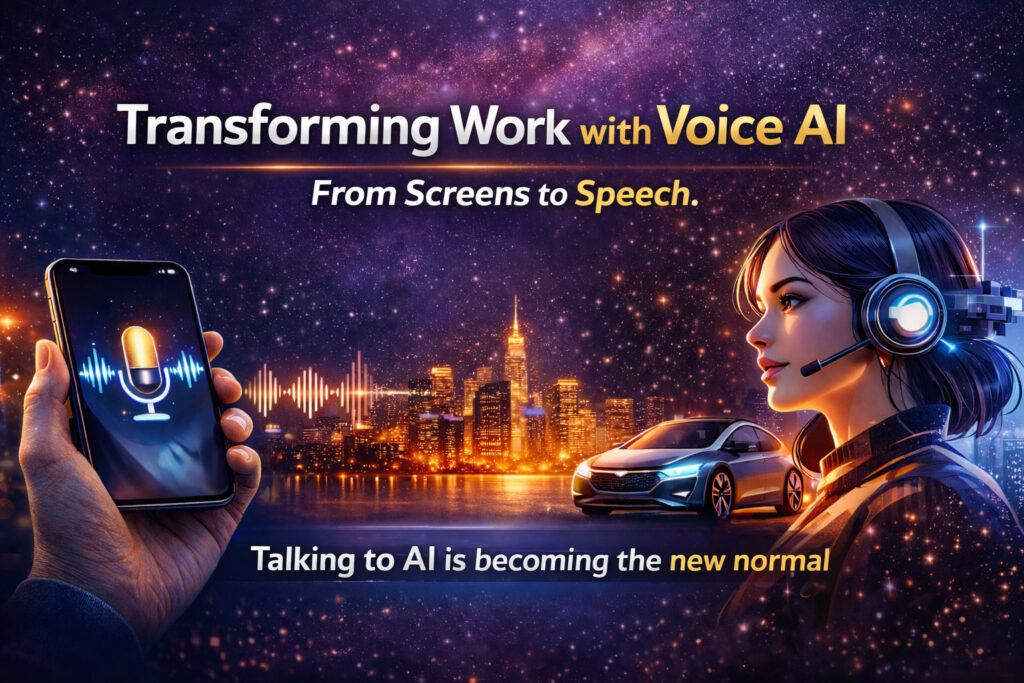
Across Silicon Valley, the way people interact with AI is fundamentally evolving, with voice becoming a central interface.
A clear example is OpenAI’s recent strategic direction.
In an article published on January 1, 2026, TechCrunch reported:
👉 OpenAI bets big on audio as Silicon Valley declares war on screens
https://techcrunch.com/2026/01/01/openai-bets-big-on-audio-as-silicon-valley-declares-war-on-screens/
According to the article, OpenAI is seriously shifting its focus from screen-based interfaces to audio-first AI experiences.
This is not simply about adding voice input.
It involves rethinking AI interaction around:
- More natural conversational pacing
- Handling interruptions and overlapping speech
- AI experiences that function without relying on screens
To support this shift, OpenAI is restructuring both its voice models and product teams.
TechCrunch describes this movement as a broader effort to move away from screen dependency.
🔍 How Voice AI Is Being Used in Practice
From the staff member’s perspective, Google Gemini and OpenAI’s voice models do not feel like direct competitors.
Instead, they serve slightly different purposes.
Google Gemini
- Well suited for quick research, task management, and photo-plus-voice interactions
- Ideal for moments that require immediate answers or fast decisions
OpenAI’s voice models
- Better suited for deeper thinking and exploration
- Useful for organizing ideas through extended conversation
The key question is no longer which AI is “better,” but rather
which AI to talk to, and in what situation.
✨ Conclusion: The Real Shift Is Learning to Talk Naturally to AI
Today, productivity is no longer defined by how fast someone can type.
It is increasingly shaped by how naturally they can communicate with AI.
Voice AI is still evolving.
However, this experience suggests that the shift is already underway.
Rather than a distant future scenario, voice-first interaction is becoming part of everyday work—quietly, but steadily.