TerraPower’s Natrium Targets AI Data Centers With Heat Storage
August 19, 2026
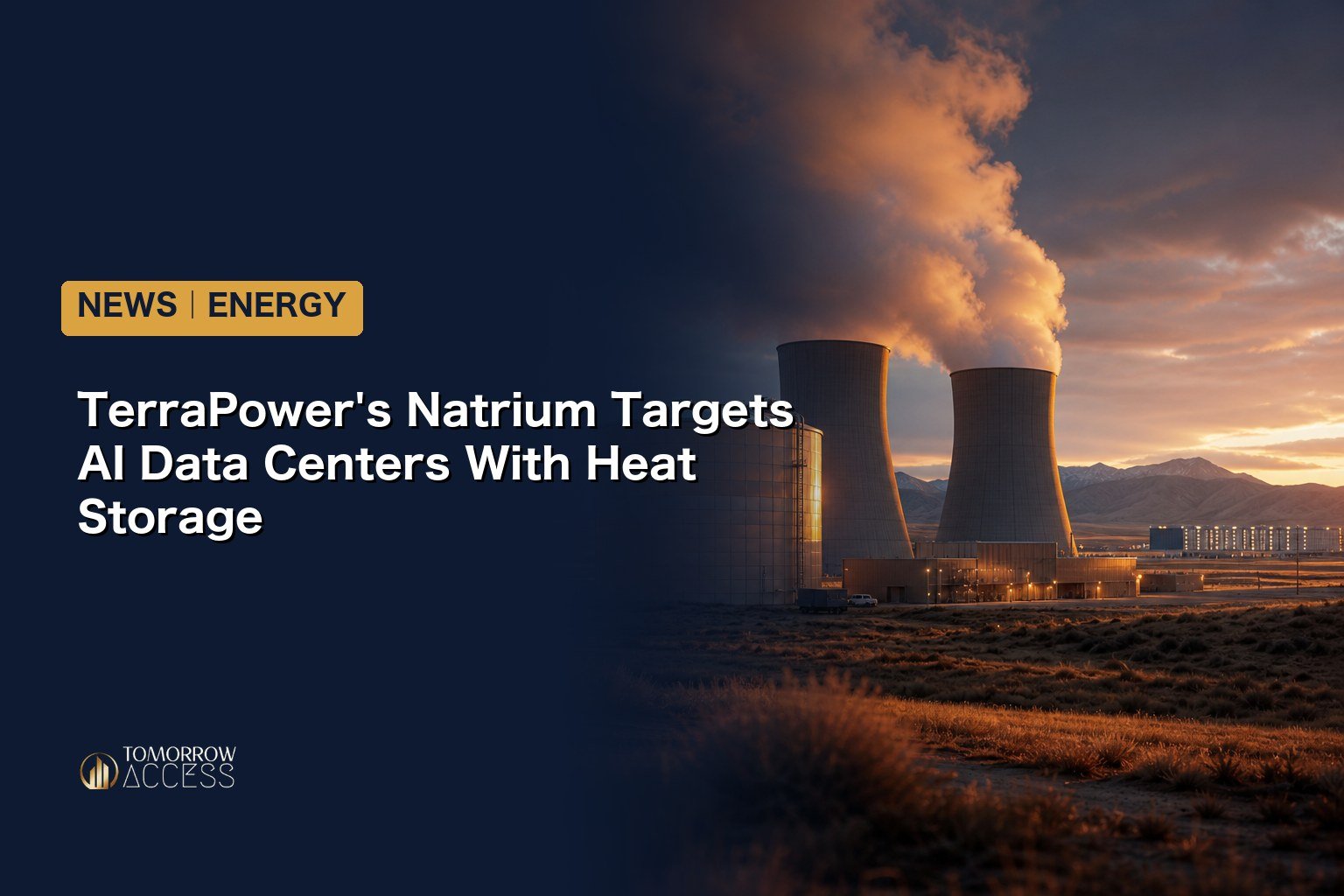
TerraPower, the nuclear startup founded by Bill Gates, is preparing to announce the company’s first power plant project for a data center, built around its Natrium reactor.
Bloomberg reported on August 18 that the company plans to announce its first data center project this year, with CEO Chris Levesque saying the plant is on track to break ground in 2027.
The company’s edge is the molten salt energy storage built into its 345 MW Natrium reactor.
A Second Plant and an Unnamed Customer
The data center project would be TerraPower’s second power plant; its first is under construction in Wyoming. The customer has not been named.
In January 2026, TerraPower announced that Meta agreed to support deployment of up to eight Natrium plants: funding early development activities for two units totaling up to 690 MW, targeted for delivery as early as 2032, plus rights to energy from up to six more units of roughly 2.1 GW targeted by 2035.
Together, the fleet could supply Meta with up to 2.8 GW of baseload power — or as much as 4 GW when the storage system boosts output.
How Natrium Stores Heat Instead of Throttling the Reactor
Natrium pairs a sodium-cooled reactor with a molten salt energy storage system. According to a U.S. Department of Energy environmental assessment, the plant can vary the electricity it delivers to the grid up to 500 MW while keeping reactor power constant.
When demand is low, heat from the reactor flows into the storage system. When demand rises, the stored heat generates additional steam, boosting output from a base of 345 MW to as much as 500 MW for more than five and a half hours, according to TerraPower — without throttling the reactor itself.
TerraPower says the storage system was originally designed to let the plant integrate seamlessly with variable renewable resources such as wind and solar.
Data Center Loads Can Swing in Seconds, While Nuclear Typically Runs at High Capacity Factors
Behind the design is the volatile power demand of data centers, including those running AI workloads. In a February 2026 experiment, researchers at the National Laboratory of the Rockies (NLR) reproduced real-world data center demand and found that it can shift sharply on a timescale of seconds — rapid fluctuations that increase mechanical stress on on-site turbines, potentially shortening equipment life and raising maintenance requirements.
The experiment demonstrated that batteries and fuel cells could respond to the rapid changes while turbine generators maintained a steadier baseload.
Nuclear power, meanwhile, typically runs as baseload at high capacity factors. According to the U.S. Energy Information Administration, the U.S. nuclear fleet ran at a 90.8% capacity factor in 2024, among the highest of any major power source. In its 2024 Annual Technology Baseline, NLR sets reference ramp rates for energy modeling at 5% of rated output per minute for large reactors and 10% for small modular reactors (SMRs).
Natrium builds that division of labor into the plant itself: reactor power can remain steady while the thermal storage system allows electrical output to respond to changing demand. The race to power AI is drawing heavy investment, including Nvidia’s $1.5 billion investment in SB Energy.
What to Watch Next
The data center customer and site remain undisclosed, and the announcement is only reported as planned for this year. Whether the project breaks ground in 2027 remains uncertain.
Progress on the Wyoming plant and on the two Meta-backed units will show whether Natrium can deliver on schedule.
Sources
TerraPower – TerraPower and Meta Enter Agreement for 8 Natrium Advanced Nuclear Plants
Bloomberg – TerraPower Plans Second US Nuclear Plant for Data Center This Year
TechCrunch – TerraPower’s nuclear reactor has a secret weapon for powering AI data centers
DOE – DOE/EA-2264: TerraPower, LLC’s Kemmerer Unit 1 Final Environmental Assessment
NLR – Evaluating Mixed Energy Resources to Meet Dynamic Power Demand of Data Centers