What an S-1 Filing Reveals That IPO Headlines Miss — from Google 2004 to SpaceX
July 24, 2026
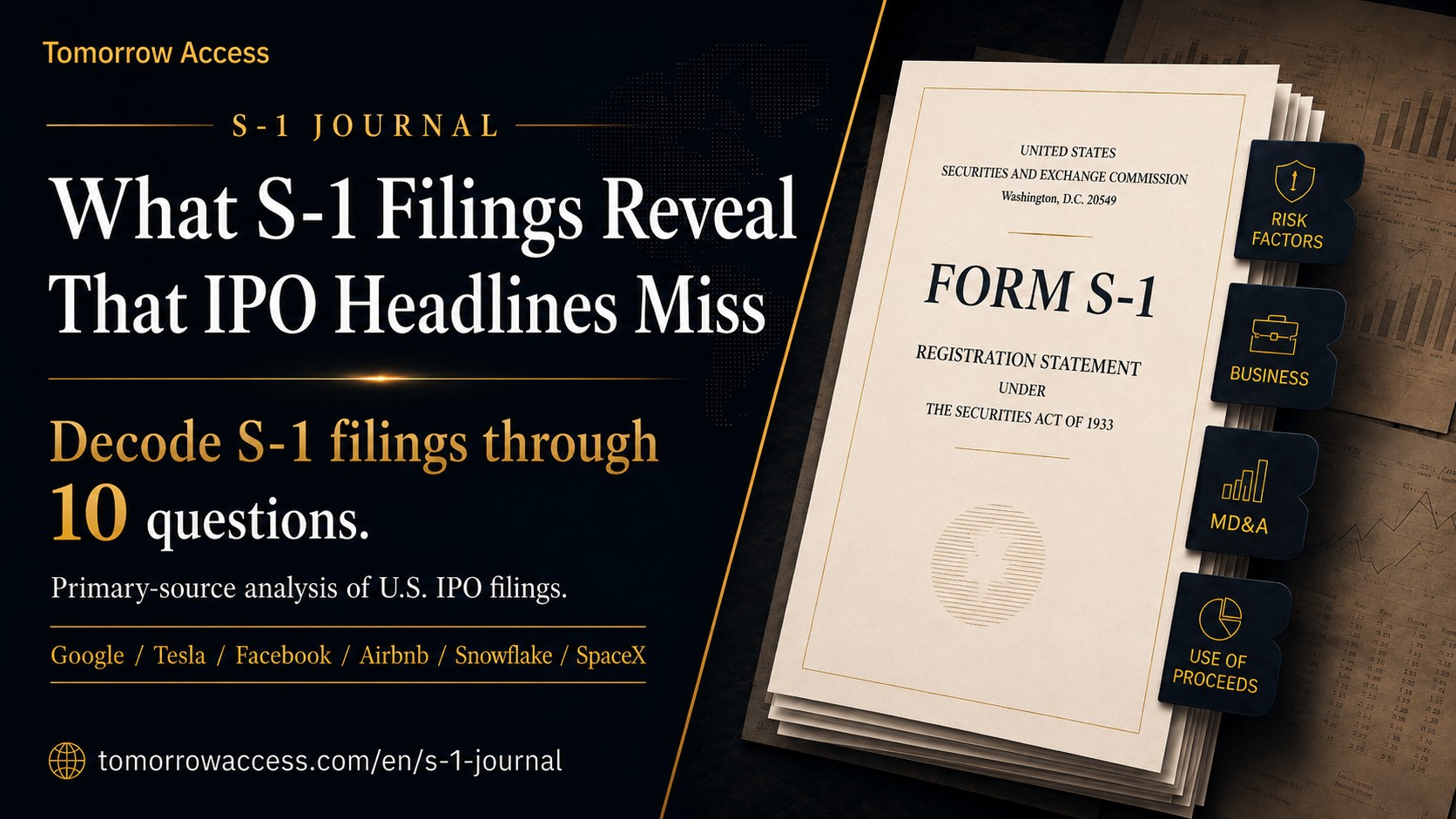
The most revealing document about a company going public is usually the one it wrote itself: the S-1 filing.
In 2010, Tesla told the SEC that it had sold exactly 937 Roadsters as of December 31, 2009—and that its future rested on the Model S, a sedan it had not yet put into production. Elon Musk’s annual base salary was listed as $33,280.
In 2012, Facebook disclosed 845 million monthly active users—roughly one for every eight people on Earth—and said its mobile products were not yet generating meaningful revenue.
In 2004, Google put in writing that its dual-class share structure would leave its founders and management team in control—even after selling stock to the public.
None of this came from leaks or investigative reporting. Each company wrote it about itself in its S-1—the basic registration statement most domestic operating companies use for a U.S. IPO.
S-1 Journal, from Tomorrow Access, exists to find those disclosures before they disappear beneath the IPO narrative.
The most honest document arrives at the most hyped moment
A material false statement or omission in an S-1 carries real legal liability. That is why the risk-factors section reads like nothing else in corporate communications: it is the company naming, in its own words, what it is actually afraid of.
The catch: a single S-1 filing runs a few hundred pages of legal prose. Most readers encounter only the headline numbers and never reach the disclosures buried deeper in the filing. Disclosures like these can sit in plain sight, largely unread.
SpaceX, by its own numbers
Take what became the largest IPO in history by gross proceeds. The headlines say rockets—but by the company’s own numbers, about 93% of the market it claims is AI.
Of the $28.5 trillion total addressable market claimed in the filing, $26.5 trillion comes from AI-related markets. Meanwhile, SpaceX’s AI segment reported an operating loss of roughly $6.4 billion in 2025. In 2025, the only segment reporting an operating profit was Connectivity—primarily Starlink.
It was all in the filing, before the first trade.
Read the opening of the SpaceX decoding free, then unlock the full ten-question analysis for $25.
Ten questions, every S-1 filing
S-1 Journal reads these filings cover to cover and decodes each one through the same ten questions:
1. What does it actually do?
2. What does it compete on?
3. How big is the market, really?
4. Who’s using it?
5. How does it make money?
6. Do the numbers hold up?
7. Who runs it?
8. Who controls it?
9. What is it afraid of?
10. Where does the money go?
One lens, every company—so a filing from 2004 and one from 2026 line up side by side. The growing archive spans more than a dozen companies, from Google’s 2004 filing to the latest 2026 filings, and a scoreboard tracks a hypothetical $1,000 invested at each company’s first-day closing price against $1,000 invested in the S&P 500 on the same day—with gains and losses alike kept on the record. See the S-1 Scoreboard.
Start free, then go deep
Five classic decodings are free to read in full: Google (2004), Tesla (2010), Facebook (2012), Airbnb (2020), and Snowflake (2020). For current filings—including SpaceX—the opening is free, and the complete ten-question decoding is available for a one-time payment of $25. No subscription.
The Filing Is Only the Beginning
The archive keeps growing: Cerebras taking on NVIDIA with the world’s largest chip, and Lime going public while retaining significant ties to Uber. And when earnings, financings, or other major events follow an IPO, S-1 Journal reads those events back against what the company originally put on the record.
→ Browse the archive and read five classic decodings free: tomorrowaccess.com/en/s-1-journal
→ See the S-1 Scoreboard: tomorrowaccess.com/en/s-1-journal/s1-scoreboard
Subscribe on the archive page to get an email when the next filing is decoded—free, unsubscribe anytime.
Disclaimer
Explanatory analysis for informational purposes only—not investment advice, a solicitation, or a recommendation to buy or sell securities. Decisions are your own. Primary sources include SEC EDGAR filings; where later events are discussed, we refer to subsequent company filings, announcements, and reputable public reporting. Scoreboard figures are hypothetical illustrations, not performance guarantees; calculations and assumptions are described on the S-1 Scoreboard page.