
BREAKING · ANSWER KEY
Figma already won. So why is it stacking on new products?
July 1, 2026 · Config 2026 keynote (June 24) + Q1 earnings × S-1
At its annual event, Config 2026, Figma announced a batch of new products and features: moving between design and code on one screen, adding motion, having AI generate components. Many are betas or staged rollouts, but the thrust was clear — layer after new layer, piled onto the software where screens get designed.
What’s odd is the hurry. Figma is already used by almost every top company in the world. It is the de facto standard in design, used by 95% of the Fortune 500. The contest looks settled. So why would a company that has already won rush to add this many products?
That answer, too, isn’t in the latest news. It’s in the registration statement — the S-1, the filing a company makes with the SEC, which includes the prospectus handed to investors.
“The customers are won; the monetization comes next”
Read the S-1, and the growth strategy Figma set for itself comes into focus. It isn’t about winning new customers — it’s about growing revenue inside the customers it already has.
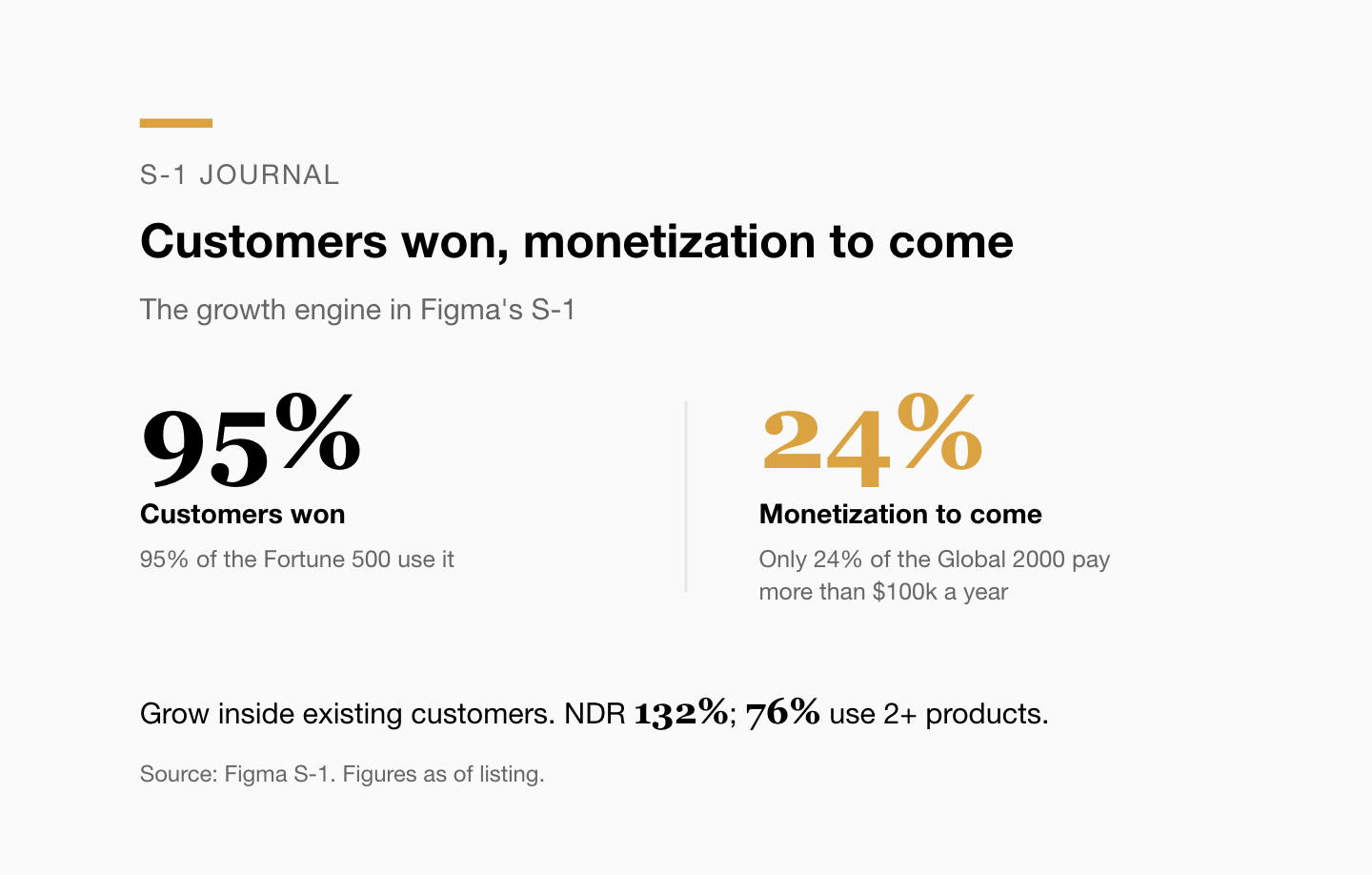
The numbers bear out the intent. 95% of the Fortune 500 and 78% of the Forbes Global 2000 use Figma. Yet the large enterprises paying more than $100,000 a year are just 24% of the Global 2000. In other words, companies everywhere use it — but many of them still pay very little.
The aim is plain: inside the organizations it has already entered, grow the number of people using it, grow the number of products they use, and lift what they pay. As of the S-1, 76% of customers already used two or more Figma products, and existing customers above $10,000 in ARR had, on average, raised what they paid by more than 30% in a year. The land is already taken. Now it harvests from that land. That was the substance of Figma’s bet.
The new products are the tools of that harvest
Seen against that bet, the Config 2026 announcements look entirely different.
The new features aren’t projectiles for winning new customers. They are tools for existing customers to do more inside Figma. Add reach — from design to code, from still image to motion — onto a single screen, and the time one user spends in Figma, and the amount an organization pays, both rise. Stack products, lift what existing customers pay: it is the strategy from the S-1, executed as written.
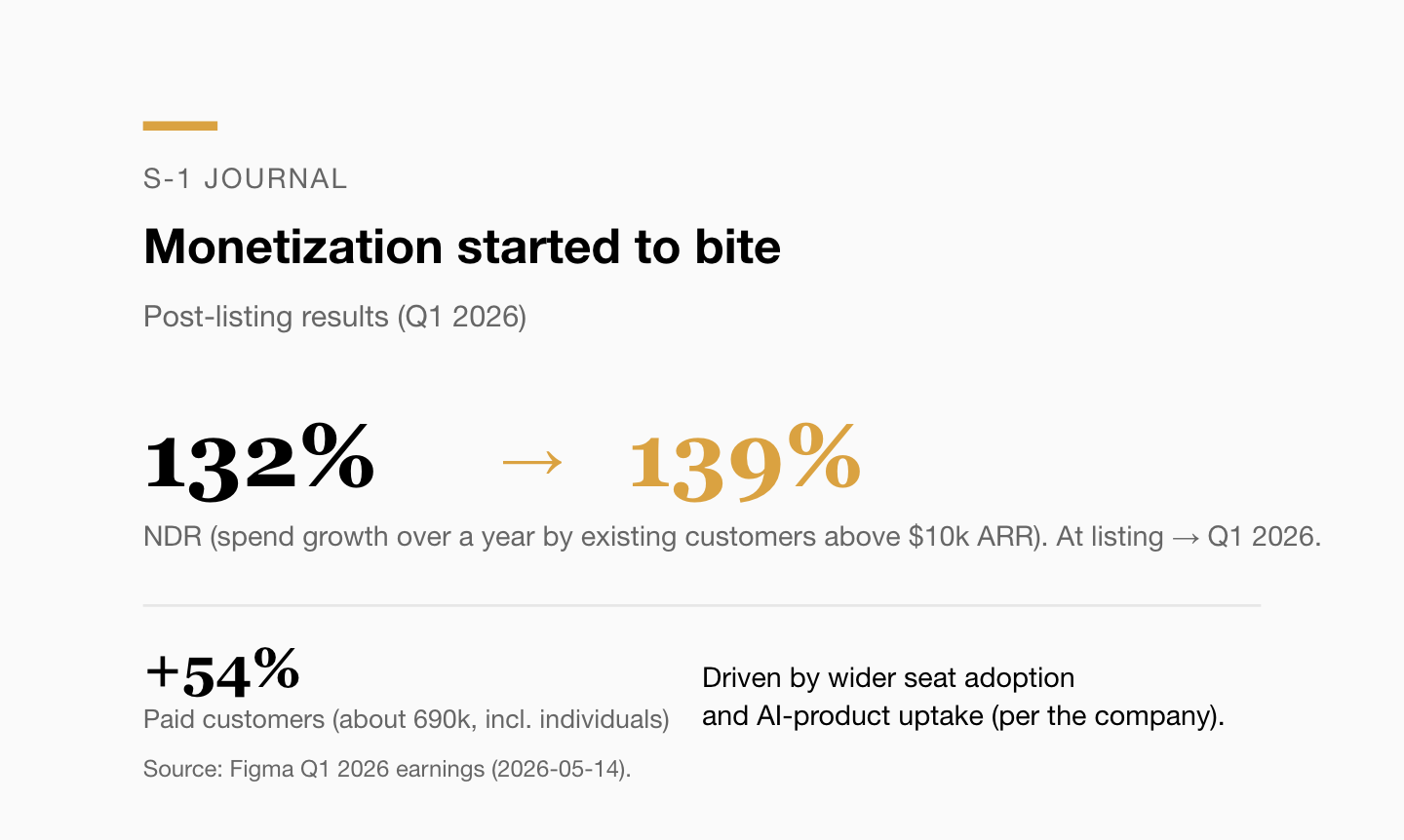
The earnings numbers show it starting to work. In the most recent quarter, net dollar retention (NDR) — how much existing customers above $10,000 in ARR grew their spend over a year — reached 139%, up from 132% at listing. Paid customers grew 54% from a year earlier, to about 690,000 (including individuals and small teams). The company raised its full-year revenue outlook, attributing it to wider adoption across organizations and to uptake of its AI products. “Monetization comes next” is now being executed — and accelerating.
The bet comes with homework, too
Not everything is a tailwind, though. The S-1 was honest about its own risks.
One is AI. Figma relies on third-party AI technology for much of its AI functionality, and it said in the S-1 that it plans to accelerate investment in its own models. So the question isn’t “does it have AI.” It is how it manages that dependence on third-party models — the inference costs, and the risks around quality, rights, and regulation. How much the new AI features loosen that dependence can’t be judged from public information alone. The other is the operational weight that grows as products multiply. The S-1 itself acknowledged the difficulty of running several products at once.
In fact, the bottom line is a loss on an accounting basis. That is not a business in trouble — it reflects listing-related costs such as stock-based compensation, and on the measure that shows the core operation’s economics, it stays in the black. Even so, a strategy of stacking products pays cost upfront, before the harvest. The execution of the bet, and the homework the bet carries, live inside the same set of results.
The reason for the hurry is one line in the filing
Chase the flash of the new products and you won’t see what Figma is after. Only by going back to the one line where it wrote, at listing, that “monetization comes next” does this announcement read as the continuation of a long strategy. In S-1 Journal, we read Figma from its listing filing through ten questions: monetization inside existing customers, the third-party AI dependence, the mechanics of founder control. Read on below.
S-1 JOURNAL NEWSLETTER
Event-driven S-1 breakdowns and new deep dives, delivered free by email. Subscriber bonus: the Ten Questions checklist (PDF). No spam. Unsubscribe anytime.
By subscribing you agree to receive emails from S-1 Journal.
The S-1-side figures in this piece rest on Figma’s filings (S-1/S-1A); the post-listing figures rest on the company’s official disclosures (its Q1 2026 earnings release and the Config 2026 blog). Post-listing share price is outside the scope of this piece, and nothing here is a recommendation to buy or sell any security.