
BREAKING · ANSWER KEY
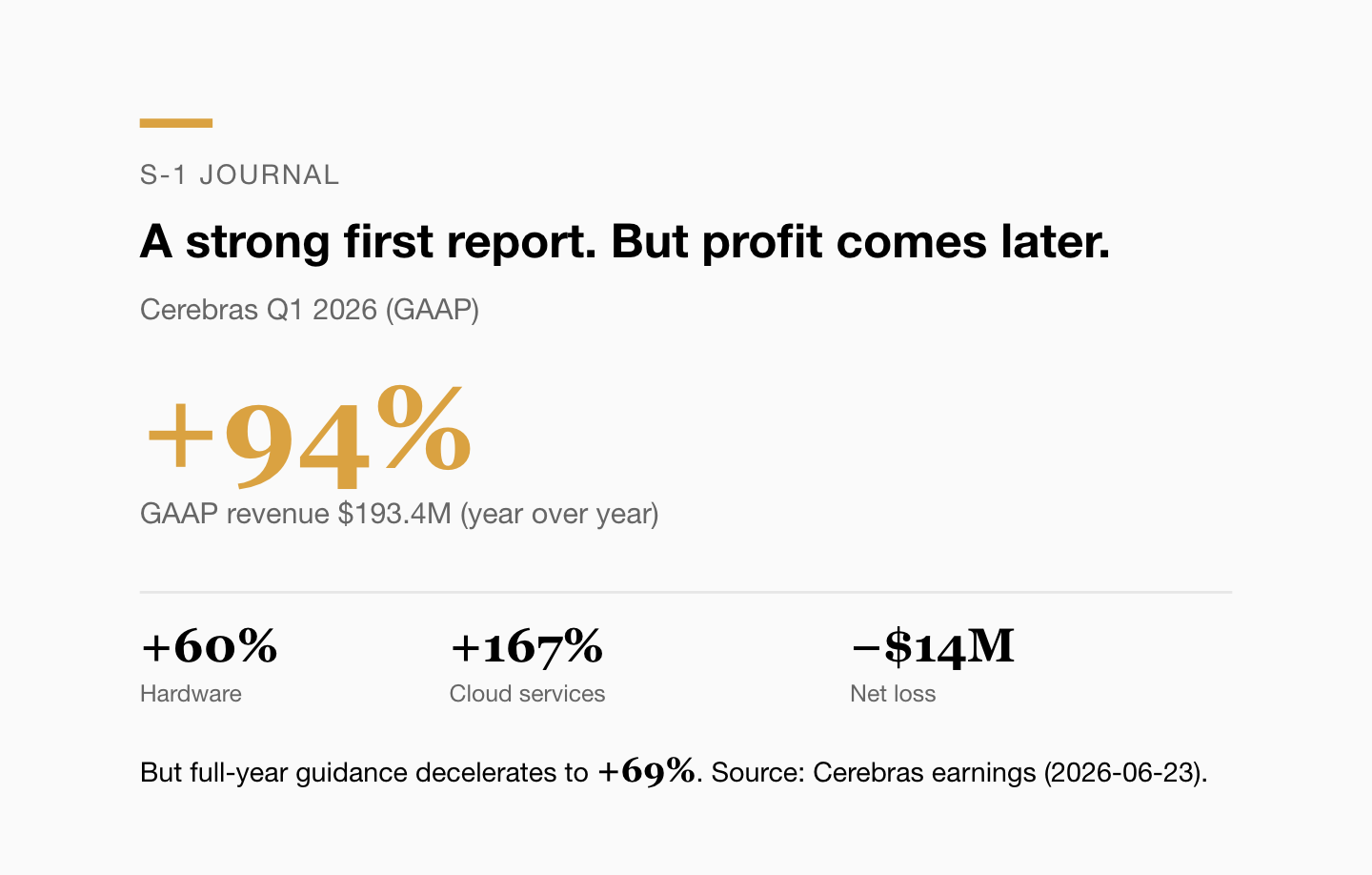
Cerebras grew revenue 94% in its first report. One weakness didn’t move.
July 1, 2026 · Q1 2026 earnings, first as a public company (June 23) × S-1 · 10-Q
Cerebras reported its first quarterly earnings as a public company. It is the company that builds the world’s largest AI chip — a single wafer-scale processor the size of a dinner plate, taking NVIDIA’s GPUs head-on.
The revenue was strong. For January through March 2026, revenue grew more than 90% year over year, and cloud-based usage more than doubled. It was a quarter that caught the full tailwind of AI demand.
But there is something the numbers alone don’t show: who is buying now, and who the company will lean on next. The answer isn’t in the earnings headline — it is in the documents the company filed, its S-1 and its quarterly report (10-Q).
Revenue still leans on barely two customers
The defining trait of this company — and arguably its greatest weakness — is customer concentration.
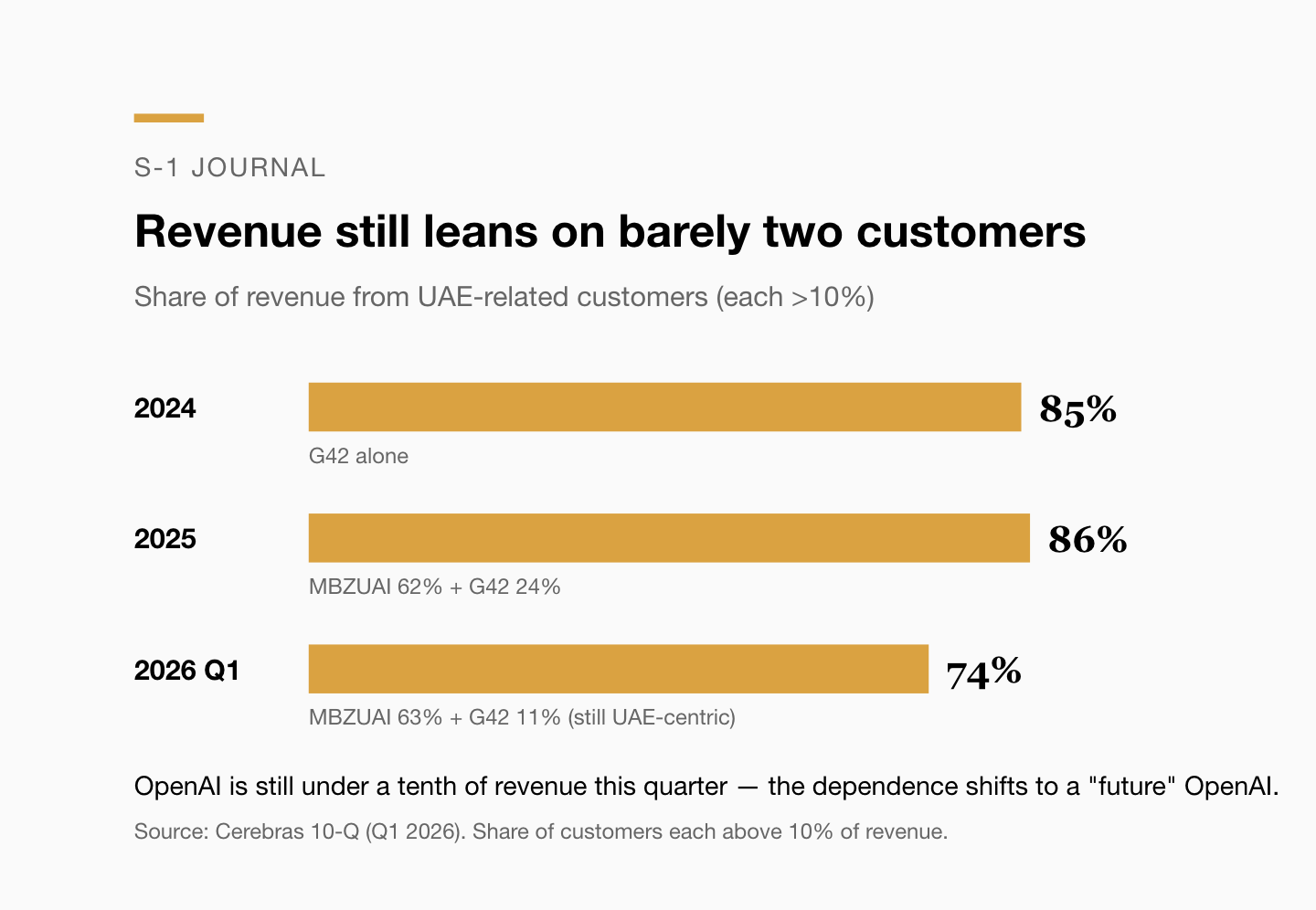
The numbers bear it out. In 2024, 85% of revenue came from a single company, G42 of the UAE. In 2025, two UAE-related customers — MBZUAI at 62% and G42 at 24% — made up 86% together. And in the first quarter as a public company, January through March 2026, the customers accounting for more than 10% of revenue were MBZUAI at 63% and G42 at 11%: about 74% still concentrated in two UAE-related names. For the company that makes the world’s largest AI chip, the shape of a business whose revenue rests on a handful of Middle Eastern customers has not changed.
OpenAI, the supposed savior, is still a “future” lead
The name raised as the rescue here is OpenAI. In December 2025, Cerebras signed a master agreement worth more than $20 billion and 750 megawatts with OpenAI. In this quarter’s report too, the company put that deal, and its partnership with AWS, front and center.
But the lead that carried this quarter’s revenue is still not OpenAI. Revenue from OpenAI only began to be recognized in the quarter, and it is not among the major customers — MBZUAI and G42 — that each exceed 10% of revenue. The company itself states that the OpenAI agreement is expected to account for a substantial portion of projected revenue over the next several years. In other words, OpenAI is the pillar of future revenue, not present revenue.
Read that way, the answer key comes into view. The weakness of customer concentration has not disappeared. Now it is the UAE; ahead, it is OpenAI. The dependence hasn’t gone — it has shifted along the timeline. That is what the documents say.
Its biggest customer is also its biggest lender
The quality of the dependence is unusual too. What OpenAI received is not the non-voting “Class N shares” themselves, but warrants to purchase them — for up to roughly 33.44 million shares. It gains an economic stake but is designed to have no say in management.
On top of that, OpenAI has lent Cerebras about $1 billion in working capital, at 6.0% annual interest. Per the 10-Q, if the master agreement terminates — for reasons other than a material breach by OpenAI — OpenAI can direct control of the funding account and demand immediate repayment of principal and interest. The biggest customer is, at the same time, the biggest lender.
And G42 has not simply reverted to being a customer either. Its original preferred-stock investment was reworked amid a CFIUS review, but warrants tied to Class N shares were subsequently issued — so the commercial and capital relationship continues in a changed form. Strong quarterly numbers and fragile, complicated relationships can both be true at once. The company also discloses a “material weakness” in its internal control over financial reporting.
The growth is real; the structure is fragile
Put it together, and it comes to this. Cerebras’s growth is real. The chip’s performance, the tailwind of AI demand, the revenue growth — none of it is in doubt. But that its revenue still leans on a few customers, that it means to rely on a different giant in the years ahead, and that this giant is also a lender — none of that shows in the quarterly revenue line alone.
It was written from the start, in the S-1 filed before listing and in the first 10-Q after it.
Where it wins, and where it could break, is in the filings
Earnings tell you what just happened. But where a company wins, and where it could break, is in the documents it filed itself. In S-1 Journal, we read Cerebras through ten questions: how it takes on NVIDIA, the true depth of its customer concentration, the design of its voting rights. Read on below.
S-1 JOURNAL NEWSLETTER
Event-driven S-1 breakdowns and new deep dives, delivered free by email. Subscriber bonus: the Ten Questions checklist (PDF). No spam. Unsubscribe anytime.
By subscribing you agree to receive emails from S-1 Journal.
This is an explanatory piece based on Cerebras Systems’ S-1/S-1A (SEC EDGAR) and the company’s Q1 2026 earnings release (June 23, 2026) and quarterly report (10-Q, period ended March 31, 2026). The Q1 2026 revenue shares (MBZUAI 63%, G42 11%), the Class N warrants to OpenAI, the working-capital loan (about $1 billion at 6.0%), and the material weakness in internal control rest on the 10-Q disclosures. Post-listing share price is outside the scope of this piece, and nothing here is a recommendation to buy or sell any security.