
BREAKING · ANSWER KEY
SpaceX had $100 billion in cash. It borrowed $25 billion more.
July 1, 2026 · $25B inaugural bond pricing (June 23) × S-1
Alongside its first-ever bond offering, SpaceX disclosed one number: about $100.8 billion in cash and cash equivalents. It had closed the largest IPO in history on June 12, and its coffers had never been fuller.
Then, on June 23, the company priced $25 billion in bonds, with settlement expected June 26. Why would a company sitting on $100 billion in cash borrow another $25 billion from the market?
Some reports tied the move to Musk’s AI ambitions and data-center plans. But the use of proceeds the company actually disclosed is far more mundane: first repay an existing bridge loan in full, cover the related costs, and put the rest toward general corporate purposes. This is not a scramble for money it lacks. It is closer to a recapitalization — swapping short-term debt for long-term, stable funding. Having secured an investment-grade rating from all three of S&P, Moody’s, and Fitch, it is locking in cheap, long-dated capital while it can.
So why build the war chest this deep? The answer is not in the bond. It is in another document — the S-1, the registration statement a company files with the SEC, which includes the prospectus handed to investors. And in it sits a fact that betrays the company’s own name.
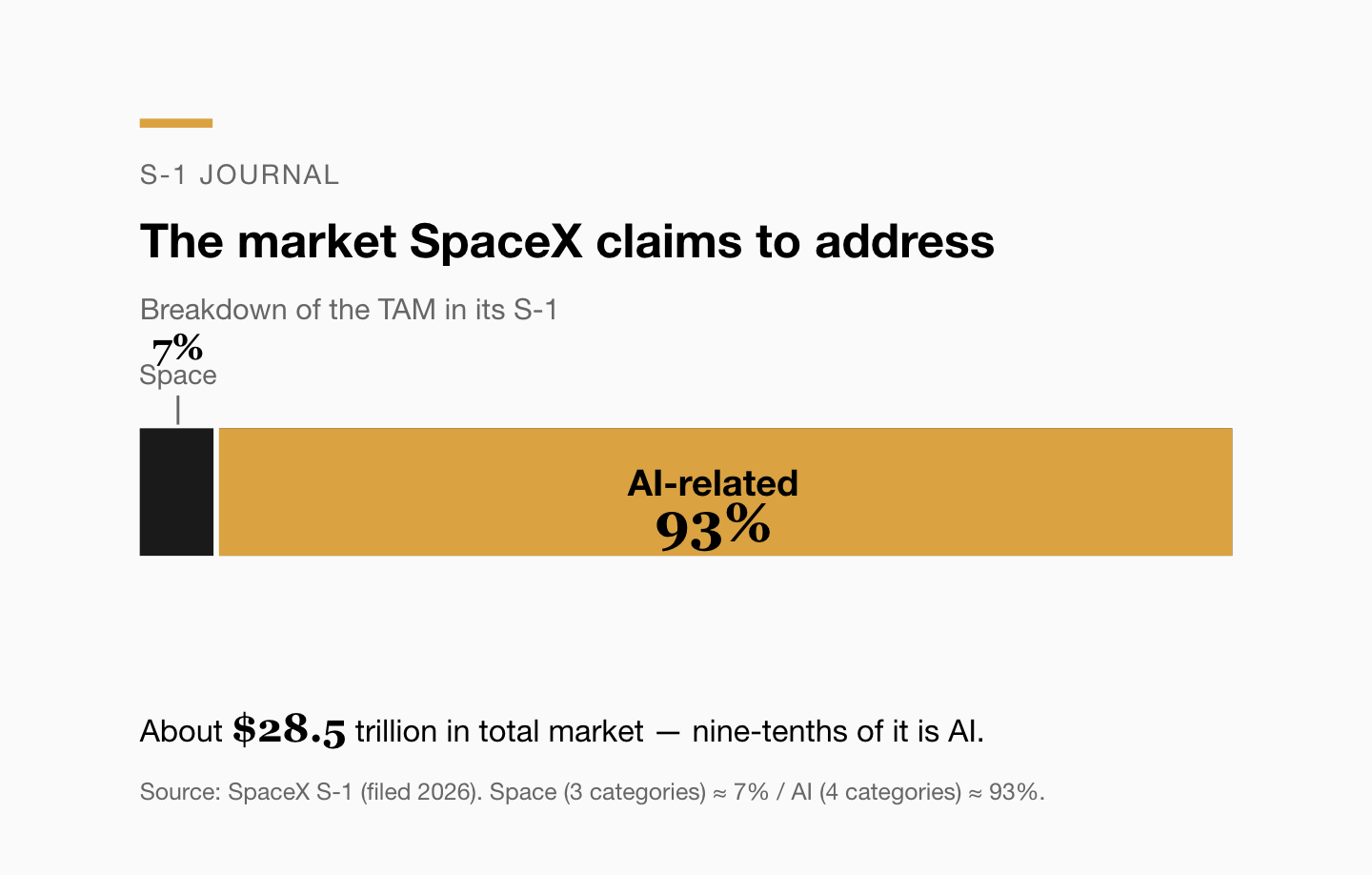
Nine-tenths of the market it claims isn’t space
The S-1 opens by sizing the market SpaceX says it can address, split into seven categories. Three of them touch space and satellite communications. Add launch and satellite services together, and they come to just 7% of the whole. The remaining 93% is AI. The total addressable market is put at roughly $28.5 trillion, and AI accounts for nine-tenths of it.
Under a name that says space, nine-tenths of the market this company is aiming at lies outside it. That is the first key to the bond’s mystery.
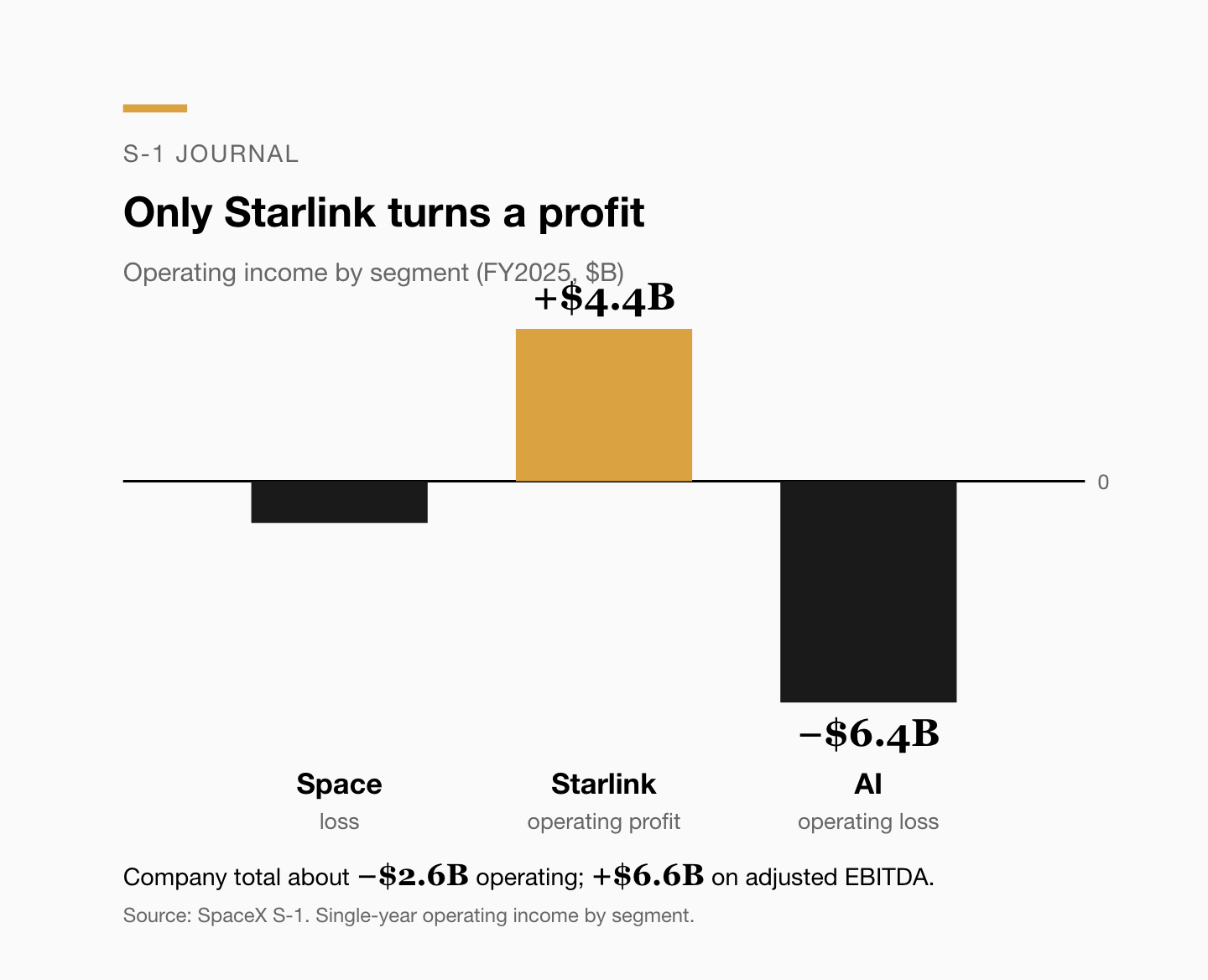
Only Starlink turns a profit
The company bundles three businesses into a single entity: Space, which handles launch; Starlink, its satellite connectivity; and AI. Of the three, only Starlink makes money.
Starlink posts roughly $4.4 billion in operating profit. Space runs a loss, and AI alone records an operating loss of about $6.4 billion in a single year. Add the three together and the company’s operating result sinks to a loss of about $2.6 billion. On an adjusted-EBITDA basis, with depreciation and the like added back, it looks like a positive $6.6 billion — but the moment you strip that adjustment away, the company is in the red.
So this is a company running a plan to settle Mars and a bet on a vast AI base at the same time, bankrolled by the connectivity fees from the satellites it has spread across the sky, its one source of profit. One wellspring of earnings, poured into two enormous bets.
The scale of that AI base is of another order too. Per the S-1, the AI supercluster in Memphis, Tennessee reaches one gigawatt of installed power capacity — the output of a full nuclear plant, devoted to a single pool of compute.
Flush with cash, it fortifies its funding anyway
Read this far, and the logic of the bond comes into view.
This company is built on the premise that it will deploy capital faster than capital comes in. Mars and AI are investments with no finish line, and Starlink’s profit alone cannot cover them. Even with $100 billion in cash, it secures cheap, long-term funding. That is not the flip side of a shortage — it is provisioning for investment that never ends. Which is why, right after the IPO, it swaps a short-term bridge loan for long-term bonds and thickens its capacity to keep investing.
Some reports tied the bond to the AI plans. But the disclosed use of proceeds names no specific AI facility. What is written is only the broad language of repaying the bridge loan and general corporate purposes. Go back to the S-1 and this reads not as borrowing for one project, but as a sign that the company as a whole structurally needs capital. The news hunts for a flashy purpose; the filing shows an impersonal structure. And the structure says far more.
What the people at the helm are looking at
One last detail captures the character of this company. On the cover of its S-1, there is not a single star. What is drawn is only the horizon of Mars, sinking into darkness. And at the front, the mission reads: “to extend the light of consciousness to the stars.” That the word “consciousness” appears in a securities filing at all is almost without precedent.
To read the bond of a company holding $100 billion in cash as a sign of distress would be premature. It is, rather, a move to shore up a funding base — using the market’s valuation and its credit ratings — so it can keep running two bets that never end: Mars and AI. The bond is merely the latest instance of that intent surfacing as numbers.
The real answer is in the S-1
The bond news is a snapshot of a single moment for this company. Why it raises money even while holding vast cash — the real answer lies in the one document SpaceX wrote about itself when it went public. In S-1 Journal, we read that registration statement through ten questions: the 93% AI hidden behind the name, the mechanics of Musk’s sole control, how it runs Mars and AI at once. Read on below.
S-1 JOURNAL NEWSLETTER
Event-driven S-1 breakdowns and new deep dives, delivered free by email. Subscriber bonus: the Ten Questions checklist (PDF). No spam. Unsubscribe anytime.
By subscribing you agree to receive emails from S-1 Journal.
This is an explanatory piece based on SpaceX’s S-1 (filed May 2026) and the company’s IR and SEC filings (the June 2026 bond issuance and pricing release, and the 8-K disclosing cash on hand). The bond was priced on June 23, with settlement expected June 26; cash and cash equivalents of about $100.8 billion were disclosed as of June 19. Post-listing share price and results are outside the scope of this piece, and nothing here is a recommendation to buy or sell any security.