
SpaceX
It’s Called SpaceX.
But 93% of the Market It’s Chasing Is AI.
On May 20, 2026, SpaceX filed its S-1 with the SEC. The legal entity is Space Exploration Technologies Corp., headquartered in Starbase, Texas. But open the filing and a second company appears beside it: xAI, founded in 2023; X, the former Twitter, which xAI acquired in 2025; Grok, folded into SpaceX in 2026; and an AI supercluster in Memphis.
This is the S-1 of a 24-year-old company that now handles more than half of the world’s launches. In 2025 it flew 170 times, and cumulatively it has lifted roughly 7,400 tonnes to orbit; Starlink reached 10.3 million subscribers by the end of Q1 2026. The filing opens by sizing every market it believes it can reach — a total addressable market it splits into seven sectors (built on third-party estimates from BCG, Ericsson, Grand View Research and others). Three are space: Space-Enabled Solutions at about $370 billion, Starlink Broadband at about $870 billion, Starlink Mobile at about $740 billion — together roughly 7% of the total. The other four are AI: AI Infrastructure, Consumer Subscriptions, Digital Advertising, and Enterprise Applications. Combined, they reach about $26.5 trillion — 93% of the TAM. The total is $28.5 trillion. It lists as “SpaceX,” yet nine-tenths of the market its own prospectus points to is artificial intelligence.
Break it down by segment and the contradiction sharpens. SpaceX runs three segments — Space, Connectivity (Starlink), and AI — and only one of them turns an operating profit: Starlink. Space booked about $4.1 billion of 2025 revenue but a roughly $0.7 billion operating loss. AI lost about $6.4 billion at the operating line in a single year, a loss the filing describes as “reflecting its earlier stage of development.” Starlink, by contrast, posted about $4.4 billion of operating income and about $7.2 billion of Segment Adjusted EBITDA. Add it all up and company-wide Adjusted EBITDA looks like a $6.6 billion profit — but strip the adjustments away and it flips to a $2.6 billion operating loss. The S-1 hands investors that gap between the adjusted number and the reported reality, unedited. (Adjusted EBITDA: operating income with non-cash items such as depreciation added back — a proxy for underlying cash generation.)
No CEO letter was filed; it is an optional item. In its place, three Elon Musk quotes are set into the body of the S-1 as images.
“Starlink internet is what’s being used to pay for humanity getting to Mars.”
“xAI is moving faster than any other company. No one is even close.”
“The future is vastly more exciting and interesting if we’re a spacefaring civilization and a multiplanet species than if we’re not.”
The mission statement reads:
to extend the light of consciousness to the stars
On the cover of the S-1 there are no stars at all — only the red horizon of Mars against the dark.
Ten questions. We lay out only what the S-1 says.
S-1 JOURNAL NEWSLETTER
Get the Ten Questions checklist (PDF) and the next S-1 reality check, free by email.
- Q1What is this company, really?
- Q2What is it competing on?
- Q3How big is the market?
- Q4Who uses it?
- Q5How does it make money?
- Q6Are the numbers healthy?
- Q7Who runs it?
- Q8Who controls it?
- Q9What does it fear?
- Q10What happens to the money raised?
- —Closing: beyond the ten questions
Q1 and Q2 are free. Q3 onward is a one-time $25 unlock. Unlock the full piece for $25 →
Question 1
What is this company, really?
Primary source · from the S-1
Prospectus Summary (Our Mission, Our Business, p.1+), Business (p.130+) — from the S-1
In one line: three businesses inside a single legal entity, controlled by one man.
Take the business in three parts.
The first is launch. Four vehicles — Falcon 9, Falcon Heavy, Starship, and Dragon — carry cargo and people to orbit.
The second is satellite broadband: internet delivered through Starlink, plus the direct satellite-to-mobile service it began in 2024.
The third is AI and a social network: Grok, the large language model built by xAI; X, the former Twitter, which xAI acquired in 2025; and the compute capacity supplied from the AI supercluster in Memphis.
The mission statement is a single sentence.
The mission is printed as an image on a dedicated page right after the cover: the dark of space, a crescent on the left, Mars on the right. Few companies put the phrase “light of consciousness” into the mission section of an SEC filing.
The cover itself is starker still. Against the dark, only the red horizon of Mars sits at the bottom of the frame. There are no stars. A mission about carrying light to the stars, on a cover with none — that is the first image SpaceX hands its investors.
Twenty-four years in, the Key Milestones light up in different years, one per segment.
— three timelines, one S-1.
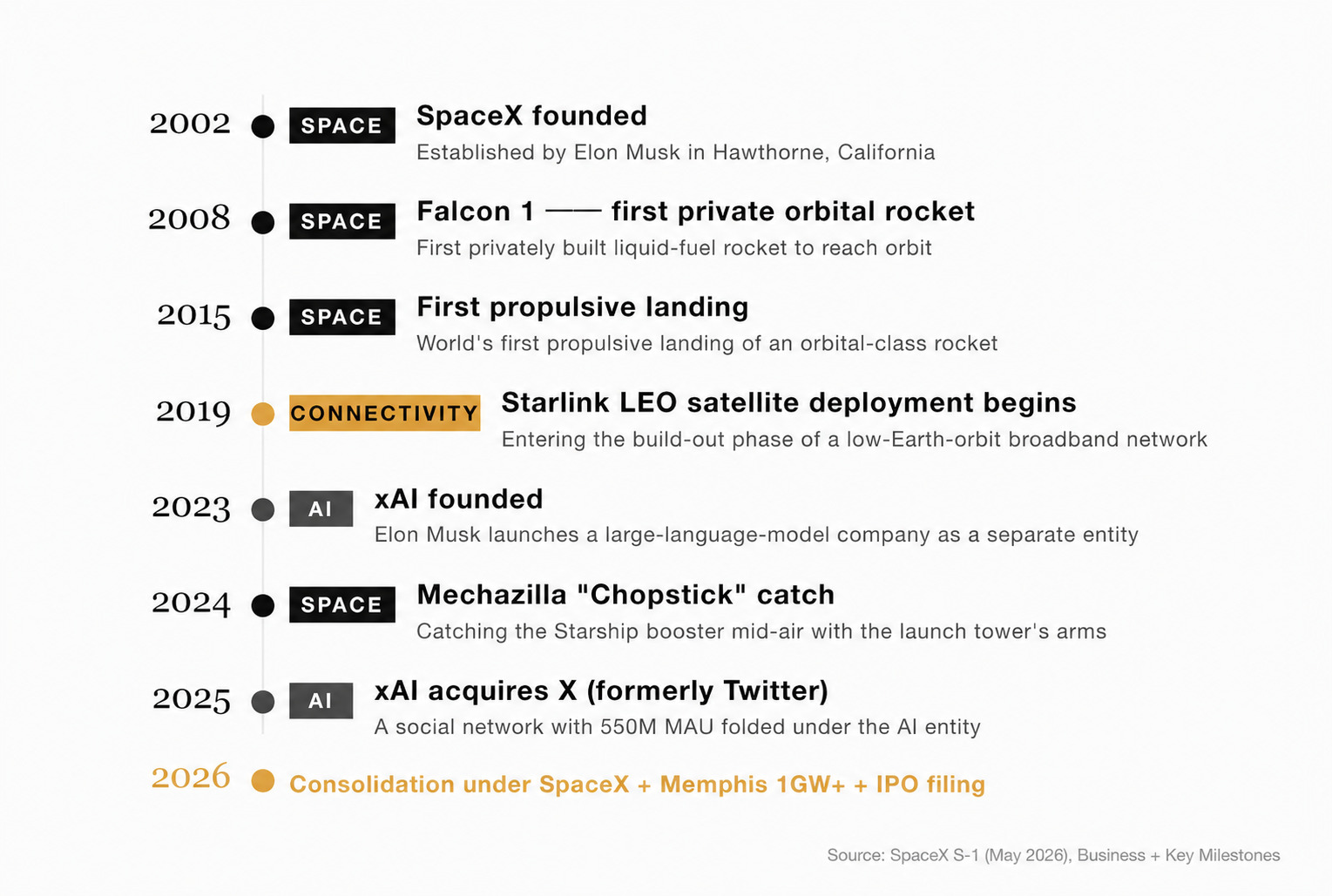
The newest year on that chart is 2026. The AI line reads “first gigawatt-scale AI training cluster and largest coherent supercomputer.” The expanded Colossus in Memphis, the filing says, came online around the time of the S-1.
That is a different order of energy — and a different engineering lineage — running inside the same company as the core launch business.
The footprint spans five factories. Starbase, Texas houses Starship production and headquarters; Hawthorne, California is the former HQ and Falcon plant; McGregor, Texas runs engine testing.
Redmond, Washington builds Starlink satellites; Bastrop, Texas is a second Starlink factory.
There are three launch sites — NASA’s Kennedy Space Center and Cape Canaveral in Florida, and Vandenberg in California — plus the autonomous droneships at sea.
On top of that: AI superclusters in Memphis, Tennessee and Southaven, Mississippi, and xAI’s headquarters and research base in Palo Alto, California.
The S-1’s “Key Infrastructure and Facilities” lists these as 11 sites. The closing line of the mission — “extend the light of consciousness to the stars” — is built, deliberately, not in one factory but across eleven.
One legal entity, three businesses running at once — that is what the S-1 contains.
Question 2
What does it compete on?
Primary source · from the S-1
Prospectus Summary (Our Competitive Strengths, p.1+), Business (The Algorithm, Vertical Integration, p.130+) — from the S-1
SpaceX’s way of competing comes down to five words.
In the Business section, the five steps Elon Musk has repeated for years are printed as a diagram, alongside photographs of three generations of the Raptor engine. The figure below isolates the five steps of what he calls “The Algorithm.”
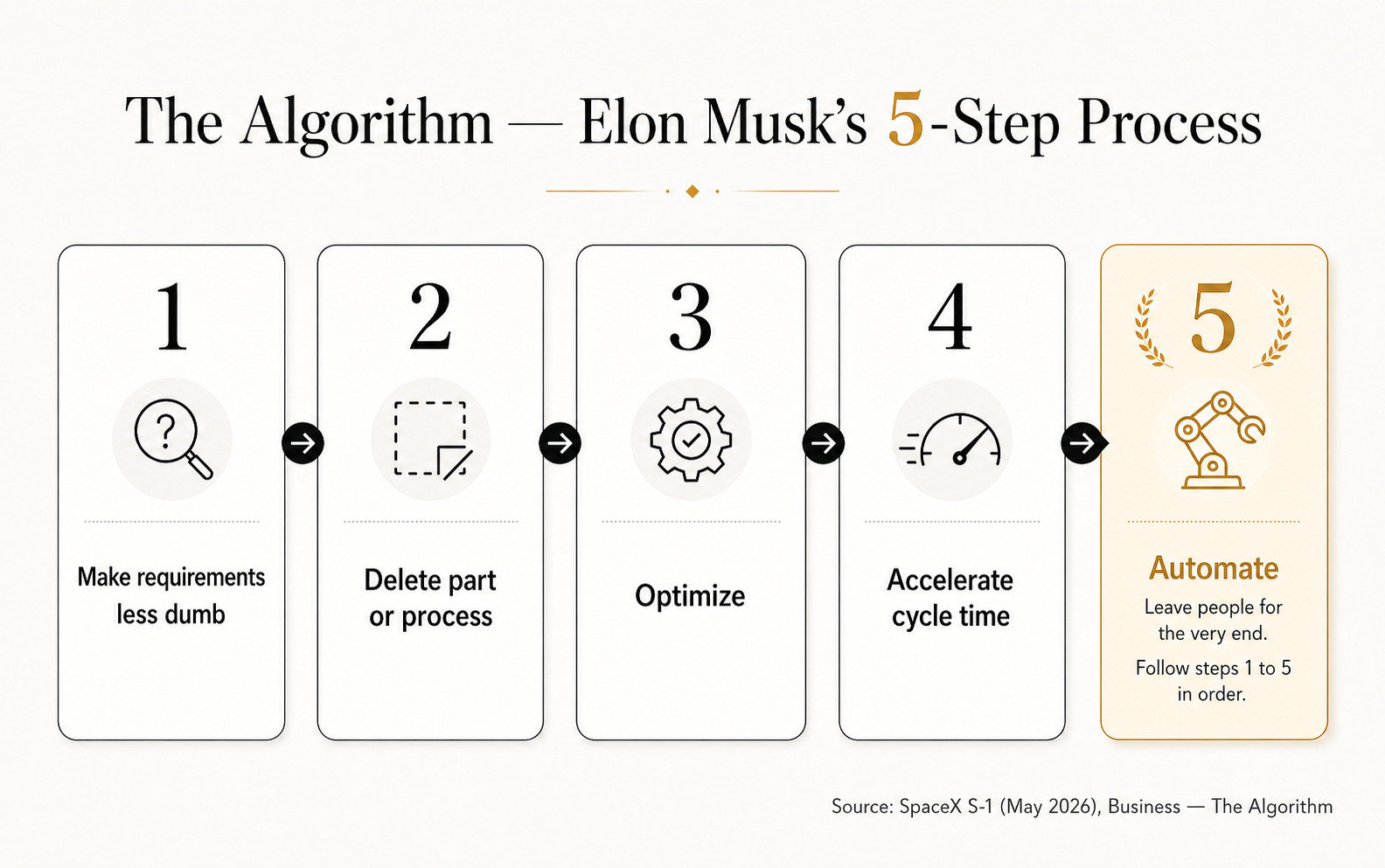
“Make the requirements less dumb” — question the spec itself
The first step is to make the requirements less dumb. Who set this requirement? Is it really needed? Question it before anything else.
That a line like this survives into an SEC filing tells you something about the culture. The lawyers would normally cut it. Musk kept it.
S-1 JOURNAL NEWSLETTER
Event-driven S-1 breakdowns and new deep dives, delivered free by email. Subscriber bonus: the Ten Questions checklist (PDF). No spam. Unsubscribe anytime.
By subscribing you agree to receive emails from S-1 Journal.
Keep reading
- Q3 How big is the market?
- Q4 Who actually uses it?
- Q5 How does it make money?
- Q6 Are the numbers healthy?
- Q7 Who runs it?
- Q8 Who controls it?
- Q9 What is it afraid of?
- Q10 What becomes of the money it raises?
- Closing Beyond the ten questions