Meta Uses Tent Structures for Part of Its AI Data Centers to Speed Deployment
June 5, 2026
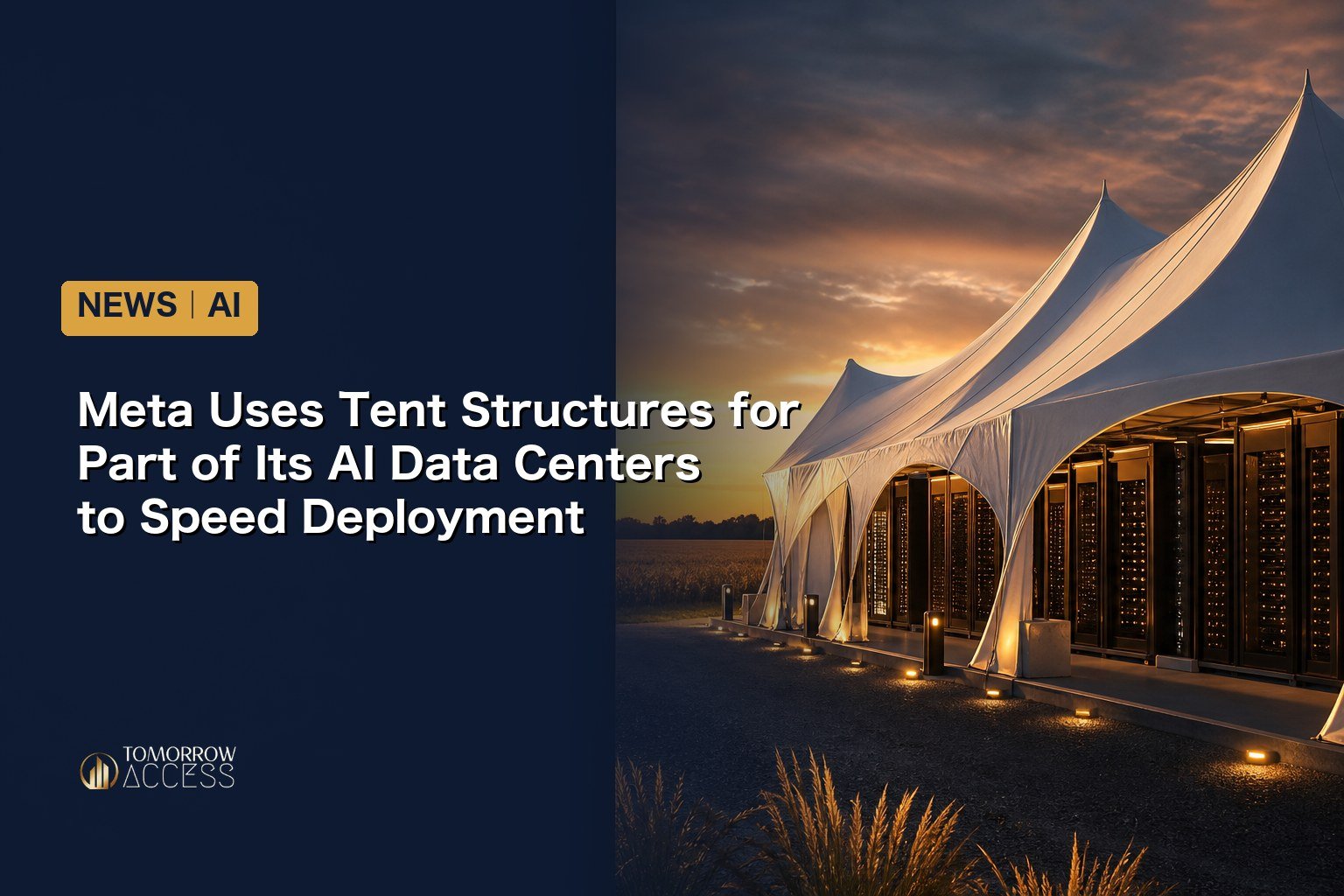
Meta has been using “tent structures” for part of its AI data centers. The aim is to sharply increase the speed at which it can stand up the facilities that house its AI servers.
Michael Thomas, founder of Cleanview, which tracks data center deployments, surfaced the project using satellite images and local building permits.
On the construction side, the move recalls the tents Tesla used while ramping up Model 3 production; on the power side, it echoes the off-grid generation approach (powering a site from its own power plants instead of the utility grid) popularized by xAI.
With Wall Street wary of Meta’s massive capital spending, Meta is putting billions of dollars of AI chips inside tent structures as a way to shorten construction time and bring AI compute online sooner.
Six Tents Outside New Albany, Ohio
According to Thomas, Meta has built six tents on the edge of New Albany, Ohio. The company calls them “rapid deployment structures.”
City building permits he reviewed show that Meta began constructing five tents, each 125,000 square feet, between April and June. Satellite images he posted on X show the structures are now complete.
Inside, AI chips likely worth billions of dollars are expected to run Meta’s workloads. Thomas described the broader moment as the AI race entering its “Mad Max phase.”
Build and Power Tactics Reminiscent of Tesla and xAI
The use of tents recalls the ones Tesla pitched in the parking lot of its Fremont, California factory while rushing to ramp up Model 3 production. The appeal is speed: a tent can bring capacity online faster than a permanent building. Meta CEO Mark Zuckerberg described a similar idea last year in an interview with The Information, outlining a plan to house multi-gigawatt data centers in weatherproof tents.
The power setup also avoids relying solely on the grid. According to Thomas, Meta has signed a 10-year deal with energy infrastructure company Williams to build two off-grid power plants near New Albany, each rated at 200 megawatts for a combined 400 megawatts — an approach close to the off-grid power popularized by xAI.
Williams’ own materials likewise describe two facilities near New Albany, “Socrates North” and “Socrates South,” each planned at 200 megawatts for a combined 400 megawatts. By pairing fast construction with off-grid power, Meta aims to compress the time from securing a site to running compute at scale.
A $125-145 Billion Capex Bill and the Muse Spark Delay
The approach reflects pressure on both cost and product. For 2026, Meta expects capital expenditures, including principal payments on finance leases, in the range of $125 billion to $145 billion. Wall Street has not welcomed the spending: according to Reuters, Meta’s stock fell 6.6% on June 5 after reports that the company is weighing a large equity raise to fund its AI infrastructure. Housing AI chips in tent structures is one way to shorten construction time and bring compute online sooner.
Meanwhile, Meta has struggled to ship its AI models to developers. According to a Wall Street Journal report, its latest model, Muse Spark, is finished, but the application programming interfaces (APIs) developers need to access it have been repeatedly delayed. The company is building fast even as the rollout lags.
What to Watch Next
The open questions are how far the tent approach scales and whether it can run reliably at full capacity. Meta is reported to be building similar structures across several sites, but their operating status and overall scale are not yet confirmed.
How the planned capital spending of $125 billion to $145 billion flows through to results, and when the delayed APIs for Muse Spark will arrive, remain points to watch. TechCrunch has reached out to Meta for comment but had not received a response as of publication.
As for the Muse Spark API, a Meta spokesperson told Reuters that it is being tested with a limited set of partners and is expected to be released this month.
Sources
Distilled (Michael Thomas) – Meta’s Data Center Strategy and the Mad Max Phase of the AI Boom
TechCrunch – Meta steals a tactic from Tesla and builds data centers in tents
Data Center Frontier – Meta’s Dual-Track Data Center Strategy
Reuters – Meta repeatedly pushes back new AI model release for developers, WSJ says
Meta Investor Relations – Meta Reports First Quarter 2026 Results
Williams – Socrates Power Solution Facilities
Reuters – Meta weighs big equity raising to finance AI infrastructure, FT reports